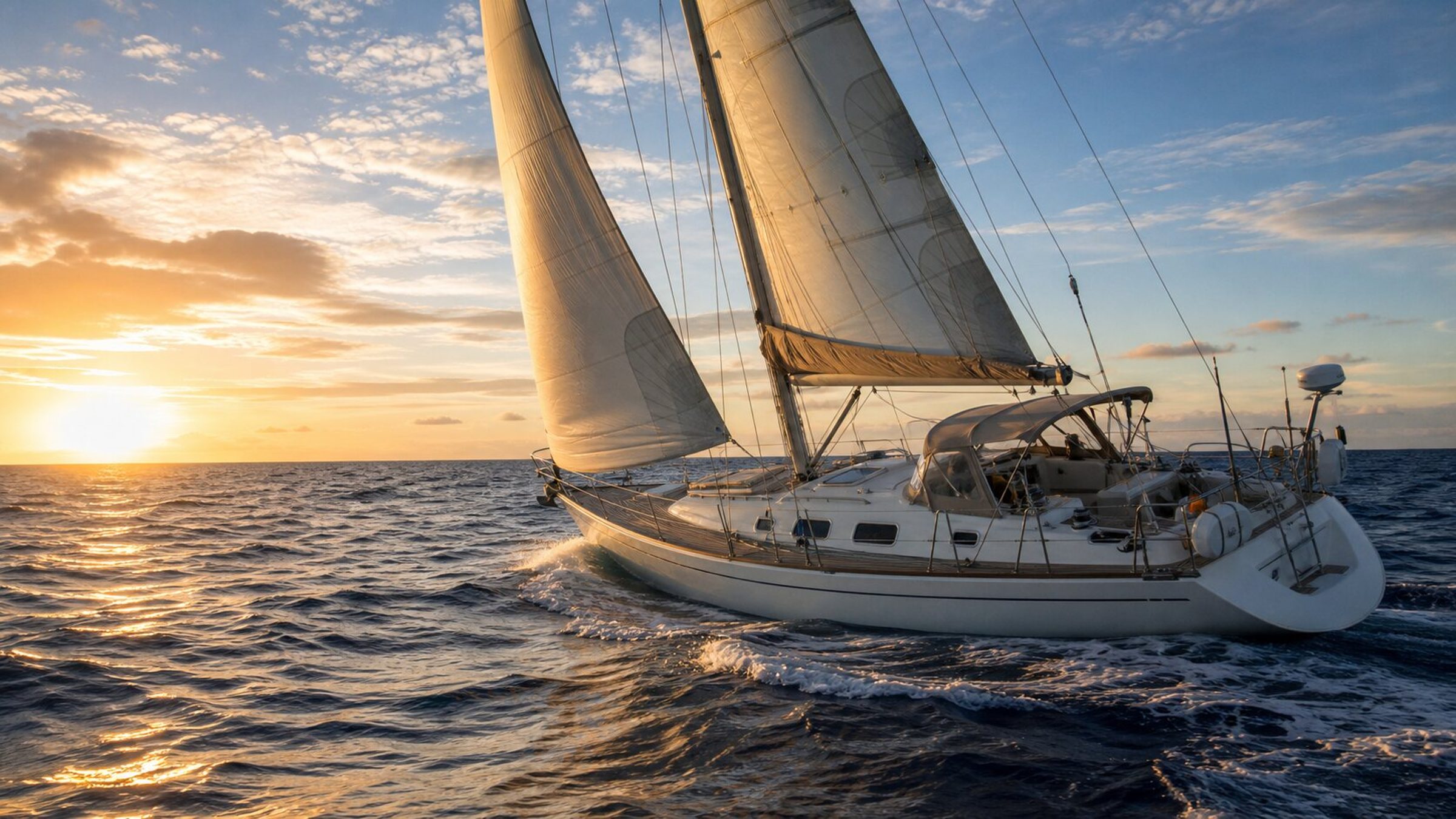
The hard constraint for bluewater sailing is not size. It is survivability. A 45-foot boat that is tender, lightly built, or difficult to control in a storm is less reassuring than a well-found 38-footer that tracks upright and forgives crew fatigue. That distinction - what separates a coastal cruiser from a genuine passagemaker - is what this guide is built around.
Under 50 feet is a practical sweet spot. These boats are large enough for real tankage, sea berths, storage, and watch-keeping comfort, but still small enough for a couple or short-handed crew to maintain and handle. The strongest candidates share a few hard characteristics: a capsize screening ratio below 2.0, a comfort ratio above 30, substantial ballast, and a skeg-hung or full-keel rudder that has some protection if the boat hits debris.
Research linkBrowse bluewater sailboats under 50 ftWhat Makes a True Bluewater Cruiser
The offshore sailing community has debated this for decades, but the consensus usually returns to a few practical attributes. Displacement-to-length ratio (D/L) tells you whether a hull carries real mass relative to its waterline. Bluewater cruisers often run D/L ratios of 200-350+. Higher D/L usually means more momentum, more motion comfort in a seaway, and more capacity for provisions, fuel, water, tools, and spares.
Ballast ratio matters too. A boat with 35-45% of its displacement in ballast has a better chance of carrying sail without turning every gust into a rail-burying event. The buyer's question is not just "will it come back up?" but "can the crew keep sailing it efficiently for days?"
Rig choice shapes offshore life profoundly. The cutter rig - a single mast with two headsails - has become a standard bearer for passage making because it breaks the sail plan into manageable pieces. It lets you sail under staysail alone in heavy air, reduces the size of each individual sail, and gives the crew more ways to balance the boat as conditions change.
Finally, rudder and keel protection. A spade rudder and fin keel can be excellent for coastal and performance sailing, but offshore the consequence of rudder damage is severe. Skeg-hung rudders and full or modified full keels are strong signals that the boat was designed with distance from help in mind.
Research linkCutter-rigged bluewater sailboats under 50 ftThe Standard Bearer: Hallberg-Rassy 46
If you ask a room of experienced bluewater sailors to name the benchmark boat in this size range, a substantial fraction will say the Hallberg-Rassy 46. Designed by German Frers and produced from 1995 to 2005, it won European Yacht of the Year on debut and later became the vessel John Neal of Mahina Expeditions used to log hundreds of thousands of offshore miles with students aboard.
The 46 displaces around 36,800 lbs with a lead keel of 14,550 lbs, nearly a 40% ballast ratio, and posts a capsize ratio of approximately 1.68. It carries its heel well, tracks without drama, and the center cockpit with its fixed windshield reduces exposure on long watches. The mahogany joinery, fit and finish, and build standards are a major reason these boats remain aspirational.
The trade-off is cost of ownership. Teak decks from the original build era are now old enough to demand close scrutiny, and deferred maintenance on a 46-foot premium cruiser becomes expensive quickly. Buyers should verify deck condition, chainplates, standing rigging, engine cooling history, and windshield or hatch sealing before treating any example as passage-ready.
Island Packet: American-Built Offshore Comfort
The Island Packet 45 represents a different philosophy that still produces a serious ocean boat. Where the HR 46 is Swedish refinement, the IP is Florida pragmatism. Bob Johnson's signature Full Foil Keel integrates the ballast into the hull rather than hanging it on bolts, protects the rudder and propeller, and gives the boat its characteristically gentle, directionally stable helm.
The IP 45 displaces 28,400 lbs with a 44% ballast ratio and drafts just 4'10", a useful combination for the Bahamas, the ICW, and anchorages that deeper offshore boats have to bypass. The shallow draft is not simply a coastal convenience; the full-foil shape and ballast package keep the capsize ratio well under 2.0.
The Island Packet 40 is the smaller sibling to consider when the 45 is more boat than you need. It carries the same construction philosophy and offshore comfort bias in a package that is easier to berth, haul, and maintain.
Known issues on both deserve real budget attention. Aluminum holding tanks age poorly. Chainplates on pre-1999 examples are 304 stainless glassed into the hull structure, so replacement or documented prior work matters. Light-air performance is the other honest limitation; below 10 knots, these boats often become motorsailers.
Research linkIsland Packet bluewater cruisersValiant: The Designer-Sailor's Choice
Robert Perry's Valiant 42 is the boat many offshore racers-turned-cruisers study when they want a bluewater hull that still rewards active sailing. It is livelier than the IP or HR, with a more modern underbody for its era, but it keeps the skeg-hung rudder and offshore build priorities that ocean miles demand. The model's circumnavigation record is a major part of its credibility.
The Valiant 50, successor to the 42, pushes the upper size limit of this guide at just over 50 feet LOA, but its 47-foot LOD keeps it in the practical range for many offshore buyers. It posts a comfort ratio of 38 and a capsize ratio of 1.68, numbers that put it firmly in serious passagemaker territory.
What the Valiants offer over the Island Packets is windward ability and light-air pace. That matters when you are crossing oceans and trying to sail an efficient course rather than waiting for the engine to solve every soft patch.
Caliber: The American Working Passage Maker
The Caliber 40 is the sleeper of this category. Michael McCreary built these in Florida specifically for extended offshore voyaging: solid fiberglass construction, skeg-hung rudder, cutter rig standard, and a capsize ratio in the 1.82 range. It lacks the romance of the Swedish and Taiwanese names, which is part of why practical buyers should look closely.
The Caliber 47 LRC (Long Range Cruiser) steps up in size and capability with a capsize ratio of 1.64, comfort ratio of 39, and 277-gallon fuel capacity. That fuel capacity is not just convenience; it changes route planning through calms, adverse currents, and weather windows.
Neither Caliber model has the prestige of the Swedish or Taiwanese builders, which is exactly why they can represent value. On paper, the 47 LRC competes directly with more famous offshore cruisers. The trade-off is ecosystem: the owners community is smaller and there are fewer brand specialists, which matters when you need troubleshooting help far from home.
The Taiwanese Builders: Tayana and Passport
The 1970s and 1980s saw Taiwan produce some of the most serious bluewater cruisers ever built. The Tayana 37, another Robert Perry design, became the go-to starter bluewater boat for a generation of circumnavigators. It is heavy for its length, comfortable in a seaway, and supported by a large enough owner base that refit knowledge is easier to find than with rarer imports.
The Passport 47 is Perry's larger Taiwanese output: a purpose-built ocean cruiser with the specs and layout to back up the name. It is rarer than the Tayana 37, so buyers should expect a longer search and more emphasis on individual condition.
The Hans Christian 43 is the non-obvious pick worth mentioning. Built by Ta Shing in Taiwan, the HC 43 is a traditional full-keel design with serious structure and a heavy seakindly motion. It is a boat for a sailor who wants a proven ocean-going hull and accepts the traditional trade-offs: slower light-air passages, more exterior brightwork, and a smaller but dedicated community.
| Boat | LOA | Displacement | Capsize Ratio | Comfort Ratio | Rig |
|---|---|---|---|---|---|
| Hallberg-Rassy 46 | 48.5 ft | 36,817 lbs | 1.68 | 38+ | Masthead sloop |
| Island Packet 45 | 45 ft | 28,400 lbs | ~1.85 | 35+ | Cutter |
| Caliber 47 LRC | 48.6 ft | 33,000 lbs | 1.64 | 39 | Cutter |
| Valiant 42 | 42 ft | ~28,000 lbs | 1.75 | 35 | Cutter/sloop |
| Tayana 37 | 37 ft | ~22,000 lbs | ~1.80 | 32+ | Cutter |
| Passport 47 | 46.6 ft | ~32,000 lbs | 1.67 | 40 | Cutter |
What to Look for Under $150K
The budget tier of this category is where the Tayana 37, Pearson 424 Cutter, and older Island Packets become most relevant. Boats in this range usually require a refit budget for standing rigging, tank inspection, seacocks, electronics, steering, and engine work. The purchase price is only the entry fee; the offshore budget is the survey findings plus the work required before departure.
The Pearson 424 Cutter is one of the more underappreciated offshore-capable boats of its era. Pearson built solid fiberglass hulls, and the 424 was designed with bluewater use in mind. It will not have the fit and finish of an HR, but a well-surveyed, well-refit example can make a rational offshore platform.
Research linkBudget bluewater cruisers under $150KThe Bluewater Boats Table
Here is the full collection of bluewater sailboats under 50 feet, filtered for capsize resistance and ocean-going displacement.
| Model ↕ | Listings ↓ | Year Built ↕ | LOA (ft) ↕ | Beam (ft) ↕ | Draft (ft) ↕ | Disp. (lbs) ↕ | Hull ↕ | Designer ↕ | Rig ↕ | Keel ↕ |
|---|---|---|---|---|---|---|---|---|---|---|
| Island Packet 40 | 46 for sale | 1994 | 40 ft | 12.92 ft | 4.67 ft | 22,800 lbs | Monohull | Bob Johnson | Cutter | Long |
| Caliber 40 LRC | 38 for sale | 1995 | 40.92 ft | 12.67 ft | 5.08 ft | 21,600 lbs | Monohull | Michael McCreary | Cutter | Fin |
| Caliber 40 | 24 for sale | 1992 | 40.92 ft | 12.67 ft | 5 ft | 21,600 lbs | Monohull | Michael McCreary | Cutter | Fin |
| Hallberg-Rassy 49 | 23 for sale | 1982 | 49.08 ft | 14.5 ft | 7.22 ft | 39,683 lbs | Monohull | Olle Enderlein / Christoph Rassy | Ketch | Fin |
| Caliber 47 Lrc | 21 for sale | 1999 | 48.58 ft | 13.16 ft | 5.16 ft | 33,000 lbs | Monohull | Michael McCreary | Cutter | Fin |
| Nicholson 32 | 18 for sale | 1962 | 32 ft | 9.25 ft | 5.5 ft | 12,200 lbs | Monohull | Charles A. Nicholson / Peter Nicholson | Masthead Sloop | Long |
| Belliure 41 | 18 for sale | 1984 | 41.01 ft | 13.16 ft | 0 | 20,680 lbs | Monohull | Peter Ibold | Cutter | Fin |
| Najad 440-1 | 18 for sale | 1986 | 43.63 ft | 13.09 ft | 7.22 ft | 31,967 lbs | Monohull | Najad | Cutter | Fin |
| Pacific Seacraft Dana 24 | 17 for sale | 1984 | 27.25 ft | 8.58 ft | 3.83 ft | 8,000 lbs | Monohull | William Crealock | Cutter | Long |
| Rustler 42 | 17 for sale | 1999 | 42 ft | 13.33 ft | 6.17 ft | 26,000 lbs | Monohull | Stephen Jones | Cutter | Fin |
| Valiant 42 | 17 for sale | 1992 | 42 ft | 12.75 ft | 6 ft | 24,600 lbs | Monohull | Robert Perry | Cutter | Fin |
| Tradewind 35 | 16 for sale | 1975 | 35.01 ft | 10.5 ft | 5.51 ft | 19,442 lbs | Monohull | John Rock | Cutter | Long |
| Fisher 37 MS | 16 for sale | 1973 | 42.52 ft | 12 ft | 5.25 ft | 31,359 lbs | Monohull | Wyatt and Freeman | Ketch | Long |
| Contest 43 | 16 for sale | 1989 | 42.65 ft | 13.12 ft | 6.4 ft | 26,000 lbs | Monohull | Dick Zaal | Masthead Sloop | Fin |
| Norseman 447 | 16 for sale | 1980 | 44.58 ft | 13 ft | 6.33 ft | 28,000 lbs | Monohull | Robert Perry | Cutter | Fin |
| Pacific Seacraft Crealock 34 | 13 for sale | 1979 | 34.08 ft | 10 ft | 4.92 ft | 12,000 lbs | Monohull | William Crealock | Cutter | Long |
| Seastream 34 | 12 for sale | 1978 | 34 ft | 11 ft | 6.23 ft | 15,000 lbs | Monohull | Ian Anderson | Ketch | Fin |
| Vancouver 34 Classic | 12 for sale | 1991 | 34.25 ft | 10.5 ft | 4.75 ft | 14,000 lbs | Monohull | Robert B Harris | Cutter | Long |
| Van de Stadt 44 | 10 for sale | 1983 | 44.33 ft | 12.83 ft | 7.08 ft | 31,752 lbs | Monohull | E. G. van de Stadt | Cutter | Fin |
| Taswell 49 | 10 for sale | 1989 | 48.83 ft | 15 ft | 6.75 ft | 32,500 lbs | Monohull | Bill Dixon | Cutter | Fin |
| Cheoy Lee Offshore 47 | 9 for sale | 1973 | 46.75 ft | 12.17 ft | 6.5 ft | 27,000 lbs | Monohull | A. E Luders | Ketch | Fin |
| Huisman 41 | 8 for sale | 1979 | 41.08 ft | 12.57 ft | 6.5 ft | 22,046 lbs | Monohull | Sparkman & Stephens | Cutter | Fin |
| Victoire 1270 | 8 for sale | 1998 | 41.67 ft | 11.94 ft | 6.89 ft | 18,960 lbs | Monohull | Dick Koopmans Sr. | Cutter | Fin |
| Island Packet 45 | 8 for sale | 1996 | 45.25 ft | 13.33 ft | 4.83 ft | 28,400 lbs | Monohull | Robert K. Johnson | Cutter | Long |
| Bayfield 40 | 7 for sale | 1982 | 45.5 ft | 12 ft | 4.92 ft | 21,000 lbs | Monohull | Ted Gozzard | Ketch | Long |
| Pearson 36 Cutter | 5 for sale | 1981 | 36.42 ft | 11.5 ft | 5.5 ft | 17,700 lbs | Monohull | William Shaw | Cutter | Fin |
| Caliber 45 | 5 for sale | 1990 | 45 ft | 13.33 ft | 5 ft | 29,000 lbs | Monohull | Michael McCreary | Cutter | Fin |
| Vancouver 32 | 4 for sale | 1986 | 32 ft | 10.58 ft | 4.5 ft | 14,000 lbs | Monohull | Robert Harris | Cutter | Long |
| Grampian 34 | 4 for sale | 1972 | 33.58 ft | 10 ft | 5 ft | 12,000 lbs | Monohull | Charles Angle/Axel Schmidt | Ketch | Fin |
| Westwind 38 | 4 for sale | 1984 | 37.92 ft | 12 ft | 4.92 ft | 19,200 lbs | Monohull | George Stadell III | Cutter | Fin |
| Rival 41 | 4 for sale | 1973 | 40.58 ft | 12.17 ft | 5.9 ft | 22,046 lbs | Monohull | Peter Brett | Cutter | Fin |
| Pacific Seacraft Crealock 44 | 4 for sale | 1990 | 44.08 ft | 12.67 ft | 6.25 ft | 27,500 lbs | Monohull | William Crealock | Cutter | Fin |
| Cabo Rico 42 Pilot | 4 for sale | 2005 | 46.5 ft | 12.67 ft | 5.25 ft | 26,939 lbs | Monohull | Chuck Paine/Ed Joy | Cutter | Long |
| Stevens 47 | 4 for sale | 1981 | 46.83 ft | 14.25 ft | 6 ft | 32,000 lbs | Monohull | Sparkman & Stephens | Cutter | Fin |
| Barbary 32 | 3 for sale | 1970 | 32.5 ft | 10.33 ft | 4.75 ft | 14,200 lbs | Monohull | Walter F. Rayner | Ketch | Long |
| Vancouver 34 Pilot | 3 for sale | 1994 | 34.25 ft | 10.5 ft | 4.75 ft | 14,000 lbs | Monohull | Robert B Harris | Cutter | Long |
| Colvic Countess 37 | 3 for sale | 1981 | 37.4 ft | 12.8 ft | 5.58 ft | 19,048 lbs | Monohull | Ian Anderson | Cutter | Fin |
| Cheoy Lee Offshore 40 | 3 for sale | 1964 | 39.75 ft | 10.75 ft | 6 ft | 20,720 lbs | Monohull | Philip Rhodes | Masthead Sloop | Long |
| Baba 40 | 3 for sale | 1980 | 39.83 ft | 12.83 ft | 6 ft | 29,000 lbs | Monohull | Robert Perry | Cutter | Long |
| Moody Grenadier 134 | 3 for sale | 1979 | 44 ft | 13.5 ft | 7 ft | 31,970 lbs | Monohull | Laurent Giles | Ketch | Long |
| Nicholson 476 | 3 for sale | 1984 | 46.67 ft | 13.67 ft | 5.83 ft | 33,000 lbs | Monohull | Camper & Nicholson | Cutter | Fin |
| C&C Landfall 48 | 3 for sale | 1980 | 47.5 ft | 14 ft | 6.58 ft | 31,600 lbs | Monohull | C&C | Cutter | Fin |
| Cape Dory 330 | 2 for sale | 1985 | 33.04 ft | 10.25 ft | 4.83 ft | 13,300 lbs | Monohull | Carl Alberg | Cutter | Long |
| Downeast 38 Kth | 2 for sale | 1974 | 38 ft | 11.83 ft | 4.92 ft | 21,000 lbs | Monohull | Henry Morschladt and Bob Poole | Ketch | Long |
| Corbin 39 CC | 2 for sale | 1979 | 38.75 ft | 12 ft | 5.5 ft | 22,800 lbs | Monohull | Robert Dufour/Marius Corbin | Ketch | Fin |
| Hutting 40 | 2 for sale | 2000 | 39.7 ft | 11.81 ft | 5.25 ft | 29,542 lbs | Monohull | Dick Koopmans Sr. | Cutter | Long |
| Cal 44 | 2 for sale | 1984 | 43.5 ft | 13.5 ft | 6.5 ft | 25,300 lbs | Monohull | Raymond Hunt & Assoc. | Cutter | Fin |
| Hylas 47 | 2 for sale | 1986 | 46.75 ft | 14.25 ft | 6 ft | 35,000 lbs | Monohull | Sparkman & Stephens | Cutter | Fin |
| Perry 41/Aloha 41 | 1 for sale | 1981 | 40.83 ft | 12 ft | 6 ft | 22,100 lbs | Monohull | Robert Perry | Cutter | Fin |
| Lafitte 44 | 1 for sale | 1978 | 44.33 ft | 12.67 ft | 6.33 ft | 28,000 lbs | Monohull | Robert Perry | Cutter | Fin |
Post-Purchase Reality
Buying the boat is the beginning of the project, not the end. Every bluewater passagemaker in this size range needs recurring attention to standing rigging, through-hulls, steering, batteries, charging, bilge systems, and the autopilot. Offshore, the autopilot is not a luxury feature; for a short-handed crew it is one of the most important systems on the boat.
The other reality: ocean cruising sailboats are not investments. They depreciate, and they keep asking for haul-outs, bottom paint, zincs, impellers, raw water pumps, diesel service, sails, canvas, and electronics. The sailors who get into trouble are often the ones who buy at the limit of their budget and leave nothing for the work that turns a good hull into a safe passage boat.
The boats in this guide were built to go offshore. They can do the job if you prepare them properly, inspect the age-related weak points honestly, and respect what the ocean requires from both crew and equipment.
Research linkFull-keel and skeg-rudder bluewater sailboats