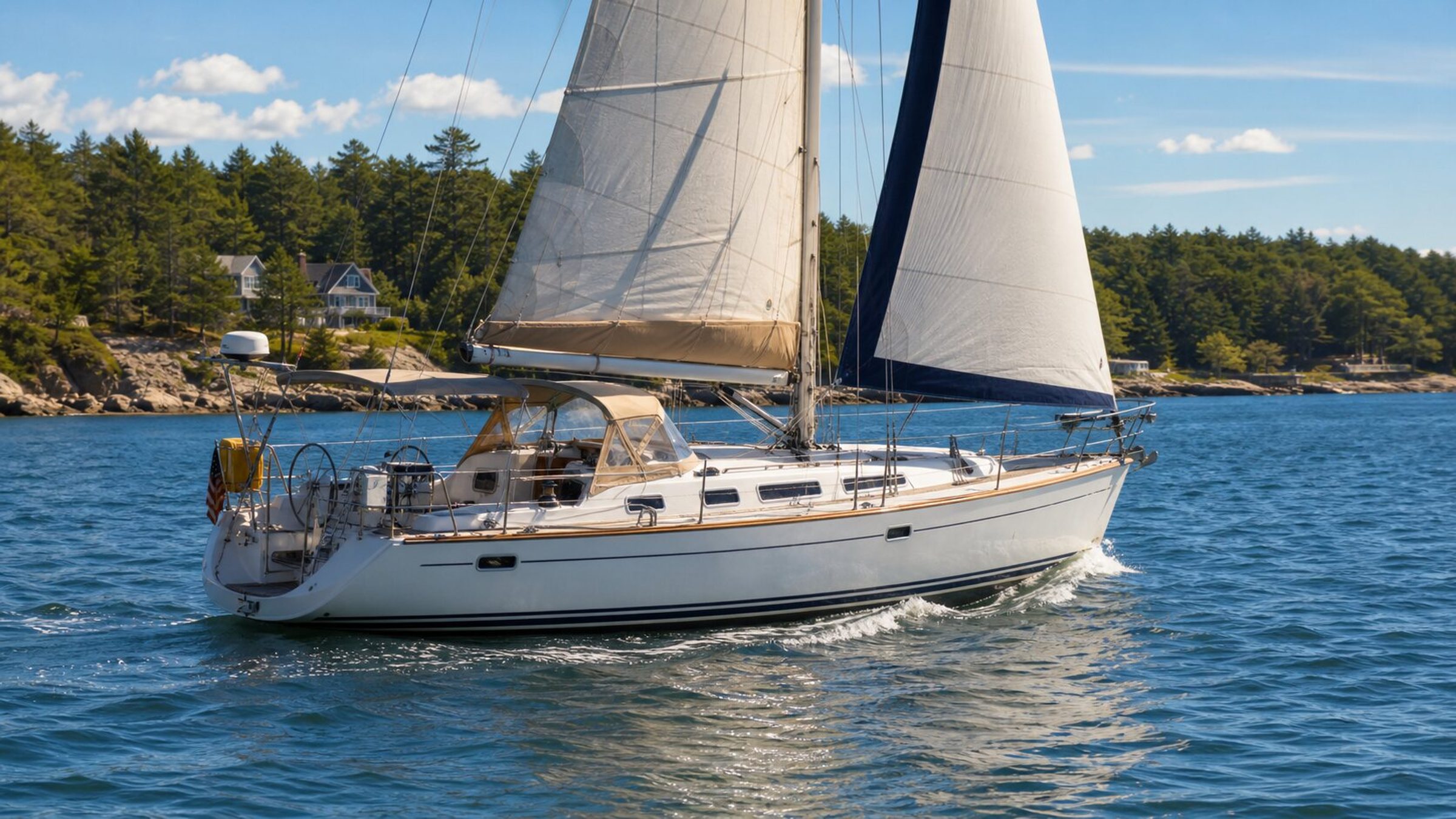
The word "cruising" covers a lot of water. It can mean a couple anchoring in a protected cove twenty miles from home, or a family planning a Pacific circuit. Both are cruising, but the boat that works brilliantly for one can be a frustrating compromise for the other. Before comparing beam, ballast, or cabin count, start with the more useful question: what kind of sailing will you actually do in the first three years of ownership?
Most sailors who say they want a bluewater passagemaker spend the vast majority of their time on coastal passages of 50 to 200 miles. That does not make safety margins irrelevant. It does mean liveaboard comfort, systems access, cockpit ergonomics, and marina handling often deserve more weight than they get in dream-boat conversations.
What Separates a Cruising Sailboat from Everything Else
A cruising sailboat is optimized for distance sailed in comfort rather than distance sailed at speed. Racing boats sacrifice stowage, headroom, and motion comfort for performance. Daysailers sacrifice tankage and offshore safety margins for simplicity. A proper cruising boat threads a third path: enough displacement to carry stores and gear, enough stability to remain manageable short-handed when conditions deteriorate, and enough interior volume to feel livable after a week aboard.
The metrics that matter most are not always the ones advertised in brochures:
- Comfort ratio (Ted Brewer's formula relating displacement to waterplane area) above 30 points toward slower, more forgiving motion in a seaway. Below 20, expect a livelier boat that may pound or hobby-horse in chop.
- Capsize screening value below 2.0 is a common offshore benchmark. Lighter, beamier boats often score above 2.0; they can be excellent coastal cruisers, but weather routing matters more.
- Displacement-to-length ratio above 250 generally means the boat can absorb cruising stores, tools, ground tackle, water, and spares without radically changing trim.
- Standing headroom of at least 6 feet 2 inches matters more after the first week aboard than it does during the boat show walk-through.
- Fuel and water tankage should match the passages you actually intend to sail. Coastal boats can often live with 30 gallons of fuel; offshore boats usually want 50 to 80, plus a realistic water plan.
| Model ↕ | Listings ↓ | Year Built ↕ | LOA (ft) ↕ | Beam (ft) ↕ | Draft (ft) ↕ | Disp. (lbs) ↕ | Hull ↕ | Designer ↕ | Rig ↕ | Keel ↕ |
|---|---|---|---|---|---|---|---|---|---|---|
| Catalina 36 Mk II | 201 for sale | 1994 | 36.33 ft | 11.92 ft | 5.83 ft | 13,500 lbs | Monohull | Frank Butler/Gerry Douglas | Masthead Sloop | Fin |
| Jeanneau Sun Odyssey 45 | 117 for sale | 2004 | 45.01 ft | 14.34 ft | 6.73 ft | 21,826 lbs | Monohull | Philippe Briand /Jeanneau | Fractional Sloop | Bulb |
| Catalina 36 | 111 for sale | 1982 | 36.33 ft | 11.92 ft | 5.83 ft | 13,500 lbs | Monohull | Frank Butler | Masthead Sloop | Fin |
| Beneteau 343 | 106 for sale | 2005 | 35.5 ft | 11.42 ft | 6.23 ft | 13,448 lbs | Monohull | Berret-Racoupeau | Fractional Sloop | Bulb |
| Catalina 350 | 105 for sale | 2003 | 35.42 ft | 12.99 ft | 6.66 ft | 12,937 lbs | Monohull | Gerry Douglas | Masthead Sloop | Fin |
| Jeanneau Sun Odyssey 389 | 102 for sale | 2015 | 38.5 ft | 12.33 ft | 6.5 ft | 15,256 lbs | Monohull | Marc Lombard | Fractional Sloop | Bulb |
| Beneteau Oceanis 361 | 100 for sale | 1999 | 36.42 ft | 12.47 ft | 5.02 ft | 12,787 lbs | Monohull | Berret-Racoupeau | Masthead Sloop | Fin |
| Beneteau 473 | 98 for sale | 2000 | 46.92 ft | 14.16 ft | 5.58 ft | 24,277 lbs | Monohull | Groupe Finot | Masthead Sloop | Bulb |
| Jeanneau Sun Odyssey 37 | 90 for sale | 1998 | 37.44 ft | 12.08 ft | 6.33 ft | 14,175 lbs | Monohull | Jacques Fauroux | Masthead Sloop | Bulb |
| Catalina 42 Mk II | 87 for sale | 1995 | 41.86 ft | 13.83 ft | 6.67 ft | 20,500 lbs | Monohull | Gerry Douglas | Masthead Sloop | Fin |
| Jeanneau Sun Odyssey 45.2 | 85 for sale | 1997 | 46.42 ft | 14.7 ft | 0 | 21,605 lbs | Monohull | Philippe Briand /Jeanneau | Masthead Sloop | Bulb |
| Catalina 355 | 69 for sale | 2008 | 35.42 ft | 12 ft | 6.66 ft | 13,800 lbs | Monohull | Gerry Douglas | Fractional Sloop | Fin |
| Beneteau Oceanis 381 | 61 for sale | 1996 | 38.58 ft | 12.92 ft | 5.33 ft | 14,991 lbs | Monohull | Berret/Racoupeau | Masthead Sloop | Bulb |
| Beneteau Oceanis 411 | 58 for sale | 1997 | 41 ft | 13 ft | 4.75 ft | 17,196 lbs | Monohull | Group Finot | Masthead Sloop | Bulb |
| Hunter 42 Passage CC | 54 for sale | 1989 | 42.5 ft | 14 ft | 4.92 ft | 24,000 lbs | Monohull | Hunter Design Team | Fractional Sloop | Wing |
| Catalina 470 | 51 for sale | 1998 | 47.67 ft | 14 ft | 7.83 ft | 27,270 lbs | Monohull | Gerry Douglas | Masthead Sloop | Bulb |
| Hunter 376 | 50 for sale | 1996 | 37.25 ft | 12.58 ft | 5 ft | 15,000 lbs | Monohull | Hunter Design | Fractional Sloop | Wing |
| Jeanneau Sun Odyssey 40 DS | 50 for sale | 2000 | 40 ft | 13 ft | 6.42 ft | 15,875 lbs | Monohull | Daniel Andrieu | Masthead Sloop | Fin |
| Beneteau 361 | 48 for sale | 1999 | 36.42 ft | 12.5 ft | 5 ft | 13,349 lbs | Monohull | Berret/Racoupeau | Masthead Sloop | Bulb |
| Catalina 400 | 48 for sale | 1994 | 40.5 ft | 13.5 ft | 6.75 ft | 18,000 lbs | Monohull | Frank Douglas/Gerry Douglas | Masthead Sloop | Bulb |
| Jeanneau Sun Odyssey 43 | 44 for sale | 1986 | 43.34 ft | 13.75 ft | 6.56 ft | 20,503 lbs | Monohull | Daniel Andrieu | Masthead Sloop | Fin |
| Beneteau Oceanis 400 | 38 for sale | 1991 | 40 ft | 12.83 ft | 5.42 ft | 19,183 lbs | Monohull | Group Finot | Masthead Sloop | Bulb |
| Hunter 466 | 35 for sale | 2002 | 46.08 ft | 14 ft | 6.5 ft | 26,180 lbs | Monohull | Hunter Design Team | Fractional Sloop | Fin |
| Catalina Morgan 440 | 32 for sale | 2004 | 45.92 ft | 14 ft | 4.92 ft | 25,528 lbs | Monohull | Gerry Douglas | Masthead Sloop | Wing |
| Catalina 400 Mk II | 31 for sale | 2000 | 41.5 ft | 13.5 ft | 6.92 ft | 19,700 lbs | Monohull | Frank Douglas/Gerry Douglas | Masthead Sloop | Bulb |
| Hunter 460 | 30 for sale | 1999 | 46.08 ft | 14 ft | 6.5 ft | 26,180 lbs | Monohull | Hunter Design Team | Fractional Sloop | Fin |
| Beneteau First 35 | 24 for sale | 1980 | 35.17 ft | 12.17 ft | 6.25 ft | 10,485 lbs | Monohull | Jean Berret | Masthead Sloop | Fin |
| Catalina 387 | 23 for sale | 2003 | 39.83 ft | 12.34 ft | 7.15 ft | 19,000 lbs | Monohull | Gerry Douglas | Masthead Sloop | Fin |
| Jeanneau Sun Fizz 40 | 23 for sale | 1980 | 40.35 ft | 12.63 ft | 6.4 ft | 16,100 lbs | Monohull | Philippe Briand | Masthead Sloop | Fin |
| Beneteau First 42 | 22 for sale | 1981 | 42.92 ft | 13.08 ft | 7.25 ft | 18,738 lbs | Monohull | German Frers | Masthead Sloop | Fin |
| Catalina 385 | 21 for sale | 2012 | 39.17 ft | 13.08 ft | 6.83 ft | 15,500 lbs | Monohull | Gerry Douglas | Fractional Sloop | Bulb |
| Beneteau Oceanis 44 CC | 21 for sale | 1994 | 44.58 ft | 14 ft | 5.75 ft | 23,369 lbs | Monohull | Bruce Farr | Masthead Sloop | Bulb |
| Jeanneau Sun Magic 44 | 20 for sale | 1987 | 43.75 ft | 13.92 ft | 6.96 ft | 22,050 lbs | Monohull | Daniel Andrieu | Masthead Sloop | Fin |
| Catalina 375 | 14 for sale | 2008 | 38.5 ft | 13 ft | 6.83 ft | 15,500 lbs | Monohull | Gerry Douglas | Fractional Sloop | Fin |
| Catalina Morgan 44 | 14 for sale | 1988 | 44 ft | 13.5 ft | 5 ft | 23,500 lbs | Monohull | Nelson/Marek | Masthead Sloop | Fin |
| Beneteau 461 | 14 for sale | 1996 | 46.59 ft | 13.95 ft | 5.74 ft | 20,944 lbs | Monohull | Bruce Farr & Armel Briand | Masthead Sloop | Bulb |
| Catalina 390 | 10 for sale | 2001 | 38.67 ft | 12.33 ft | 7.17 ft | 19,000 lbs | Monohull | Gerry Douglas | Masthead Sloop | Fin |
| Catalina Morgan 45 | 10 for sale | 1991 | 45.25 ft | 13.75 ft | 5.33 ft | 25,000 lbs | Monohull | Nelson Marek | Masthead Sloop | Fin |
| Beneteau Sense 46 | 10 for sale | 2013 | 46.32 ft | 14.53 ft | 6.73 ft | 26,014 lbs | Monohull | Berret Racoupeau/Nauta | Fractional Sloop | Bulb |
| Hunter 37 | 9 for sale | 1978 | 37 ft | 11.85 ft | 5.08 ft | 17,800 lbs | Monohull | John Cherubini | Cutter | Fin |
| Catalina Morgan 38 | 8 for sale | 1993 | 38.42 ft | 12.33 ft | 6.5 ft | 17,500 lbs | Monohull | Gerry Douglas | Masthead Sloop | Fin |
| Jeanneau Sun Fast 40 | 8 for sale | 2003 | 40 ft | 12.92 ft | 6.33 ft | 16,094 lbs | Monohull | Daniel Andrieu | Fractional Sloop | Bulb |
| Jeanneau Sun Odyssey 42 CC | 6 for sale | 1996 | 42.16 ft | 13.45 ft | 6.56 ft | 18,960 lbs | Monohull | Guy Ribadeau Dumas | Masthead Sloop | Bulb |
| Catalina Morgan 43 | 6 for sale | 1985 | 43 ft | 13.5 ft | 6 ft | 23,500 lbs | Monohull | Nelson Marek | Masthead Sloop | Fin |
| Catalina 356 | 4 for sale | 2024 | 36.5 ft | 12 ft | 6.67 ft | 16,800 lbs | Monohull | Gerry Douglas | Fractional Sloop | Fin |
| Jeanneau Sun Odyssey 47 | 4 for sale | 1991 | 47.24 ft | 14.6 ft | 6.89 ft | 26,455 lbs | Monohull | Philippe Briand | Masthead Sloop | Bulb |
| Beneteau Evasion 36 | 3 for sale | 1990 | 35.43 ft | 12.63 ft | 4.83 ft | 12,125 lbs | Monohull | Philippe Briand | Masthead Sloop | Fin |
| Jeanneau Voyage 12.5 | 3 for sale | 1987 | 41 ft | 13.33 ft | 5.42 ft | 17,967 lbs | Monohull | Guy Ribadeau Dumas | Masthead Sloop | Fin |
| Beneteau Sense 43 | 2 for sale | 2011 | 43.16 ft | 14 ft | 6.58 ft | 22,200 lbs | Monohull | Berret-Racoupeau | Fractional Sloop | Bulb |
| Jeanneau Sun Odyssey 47 CC | 2 for sale | 1991 | 47.24 ft | 14.6 ft | 6.89 ft | 27,558 lbs | Monohull | Philippe Briand | Masthead Sloop | Bulb |
Hallberg-Rassy 40
The Hallberg-Rassy 40, designed by Germán Frers and produced from 2002 to 2017, is a clear expression of the Swedish builder's philosophy: a center-cockpit ocean cruiser that is genuinely pleasant to live aboard at sea. The fixed windshield and protected helm — sometimes dismissed as conservative — become quietly revelatory after three days of wet offshore sailing. The hull is fast by bluewater standards, the Frers underwater profile tracks cleanly, and the mahogany interior is finished to a standard most production builders do not attempt.
The Hallberg-Rassy commands a significant price premium on the secondary market and earns it. It holds value because serious offshore sailors understand the construction, cockpit protection, and long-distance ergonomics behind the name. For buyers who can find one within budget, it routinely appears on short lists alongside newer boats with flashier interiors.
For similar offshore DNA at a different price point, the Valiant 42 — designed by Robert Perry — remains one of the most respected offshore designs of the 1980s and 1990s. Its skeg-hung rudder, moderate displacement, and high-quality construction have carried couples around the world for decades.
The Catamaran Alternative
The cruising market is no longer monohull-only, and any honest 35-to-50-foot roundup has to acknowledge how many buyers now cross-shop multihulls. A cruising catamaran trades the monohull's heeling, motion-comfort math, and offshore self-righting story for things many couples and families value more in daily use: level sailing, shoal draft, separation between cabins, and two to three times the interior volume at the same length.
The Nautitech 40 Open is the standout in this segment by sheer market depth — 90 active listings, more than any single monohull in this article. Built by Nautitech and designed by Marc Lombard from 2015 onward, it is a genuine performance cruiser rather than a charter condo: a single-level cockpit-to-saloon layout, twin outboard helms, and enough rig to sail rather than motor between anchorages. The trade-offs are inherent to production cats — a capsize screening value well above the 2.0 monohull threshold, stricter offshore weather management, higher marina costs, and a price floor above comparable monohulls. For Caribbean and coastal cruising with a family aboard, it is one of the most liquid modern multihulls a shopper will encounter.
Post-Purchase Reality: The First Year of Cruising
The gap between buying a cruising boat and actually going cruising is where most dreams stall. A realistic first-year timeline looks like this:
Months 1–3: The survey surprise. A professional marine survey on a 15- to 25-year-old production boat will find items. Budget 10 to 15 percent of the purchase price for deferred maintenance on any boat over 15 years old. Common items include standing rigging replacement, diesel injection service, seacock replacement, hose replacement, battery upgrades, and electronics updates.
Months 3–6: Learning the boat. Sail the boat you bought before you modify it. Most experienced offshore sailors recommend substantial coastal mileage before a first ocean passage. This is not timidity; it is the process of learning how the boat behaves, what breaks under load, and which planned upgrades are genuinely necessary.
Months 6–12: Targeted upgrades. After sailing the boat for a season, the list of necessary modifications becomes shorter and more honest. Reliable self-steering, a water plan, properly led jacklines, an EPIRB, and reefing systems that work from the cockpit are near-universal offshore priorities. Everything else depends on route and crew.
The other reality worth stating plainly: the cost of a cruising boat is not the purchase price. It is the purchase price plus one to two years of intensive maintenance and upgrade costs, plus ongoing annual costs of 10 to 15 percent of boat value for insurance, slip or mooring fees, maintenance, and equipment. Sailors who plan for that number from the beginning have a fundamentally different experience than those who discover it after the fact.
What to Look for at the Dock
When evaluating a specific boat, start at the chainplates and work outward. Signs of water intrusion at deck hardware, chainplate covers, and portlights indicate a boat that has been neglected at the detail level — and boats neglected in visible places are often neglected in invisible ones. Check the bilge for standing water and oil contamination. Operate every seacock. Look at keel bolts for rust staining or weeping where the design has external ballast. Inspect rudder bearings, steering cables, and autopilot drive mounts, because those are the systems that turn inconvenience into danger offshore.
Below decks, run every system: engine start, bilge pumps, freshwater pressure, navigation electronics, VHF, refrigeration, and charging. Turn on the stove and verify the fuel system. Open the battery compartment and check the age, connections, and bank capacity. A boat with a documented systems log is worth more than a cosmetically identical boat where the owner "thinks" things work.
The best cruising sailboat is not necessarily the most beautiful, the fastest, or the most famous. It is the one that is mechanically sound, appropriately fitted out for your intended sailing, and sized to be managed by your actual crew on a tired day. Start there, and the ocean becomes much more accessible.