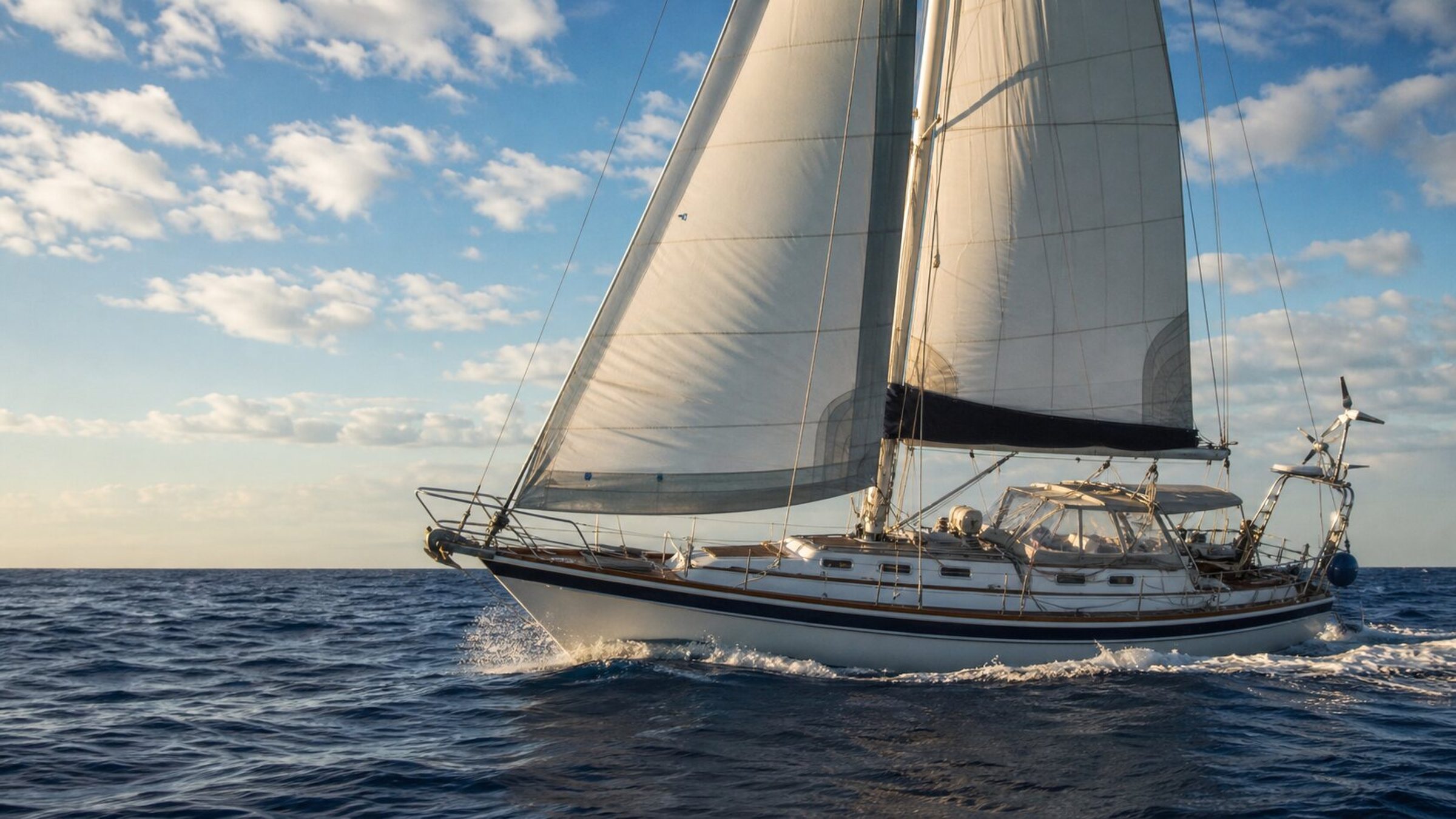
The small-boat bluewater trade-off
Every boat under 40 feet that claims offshore capability has to solve the same tension: seaworthiness asks for weight, ballast, protected appendages, and strong scantlings, while a small crew needs a boat it can actually sail, reef, dock, and maintain. Add too much displacement and you get a hull that is kind in a seaway but exhausting in light air. Cut too much weight and you lose the momentum and stability that keep the boat settled when the weather turns. The sub-40-foot boats with real bluewater reputations are the ones that found a workable compromise.
A "bluewater sailboat" is not a single hull type or rig. It might be a cutter, sloop, or ketch. What matters is the working package: construction that can absorb repeated loads, a hull form that stays predictable in breaking or confused seas, enough tankage and stowage for real self-sufficiency, and a rig that can be shortened when the crew is tired. In this size range, the proven offshore boats usually share several traits: moderate to heavy displacement, a ballast-to-displacement ratio above 35%, a skeg-hung or full-keel rudder, and a cutter or cutter-rigged sloop for flexible sail reduction.
Research linkBrowse all bluewater-capable sailboats under 40 ftBest Bluewater Sailboat Models Under 40 Feet
If you are shopping for an ocean-capable boat in this range, start with models that have repeated passage records and visible owner communities. The boat itself matters, but so does the accumulated knowledge around tank replacements, chainplate access, deck leaks, steering gear, and rig upgrades.
| Model ↕ | Listings ↓ | Year Built ↕ | LOA (ft) ↕ | Beam (ft) ↕ | Draft (ft) ↕ | Disp. (lbs) ↕ | Hull ↕ | Designer ↕ | Rig ↕ | Keel ↕ |
|---|---|---|---|---|---|---|---|---|---|---|
| Jeanneau Sun Odyssey 490 | 173 for sale | 2018 | 48.5 ft | 14.67 ft | 7.33 ft | 24,890 lbs | Monohull | Philippe Briand | Fractional Sloop | Bulb |
| Beneteau 50 | 67 for sale | 1995 | 50.75 ft | 14.67 ft | 7.55 ft | 28,660 lbs | Monohull | Farr Yacht Design/Armel Briand | Masthead Sloop | Bulb |
| Jeanneau Yachts 60 | 60 for sale | 2021 | 59.97 ft | 17.06 ft | 8.37 ft | 44,467 lbs | Monohull | Philippe Briand/Andrew Winch | Fractional Sloop | Bulb |
| Jeanneau Sun Odyssey 439 | 51 for sale | 2011 | 43.77 ft | 13.91 ft | 7.22 ft | 21,781 lbs | Monohull | Philippe Briand | Fractional Sloop | Bulb |
| Jeanneau Yachts 64 | 49 for sale | 2015 | 65.94 ft | 17.72 ft | 9.68 ft | 68,343 lbs | Monohull | Philippe Briand | Fractional Sloop | Bulb |
| Gozzard 36 | 28 for sale | 1985 | 36 ft | 12.5 ft | 4.75 ft | 18,150 lbs | Monohull | Ted Gozzard | Cutter | Fin |
| Dehler 41 CR | 20 for sale | 1999 | 40.85 ft | 12.8 ft | 6.56 ft | 19,621 lbs | Monohull | Judel/Vrolijk | Fractional Sloop | Bulb |
| Beneteau Sense 51 | 19 for sale | 2016 | 51.05 ft | 15.94 ft | 7.38 ft | 34,204 lbs | Monohull | Berret Racoupeau Yacht Design | Masthead Sloop | Bulb |
| Shannon 38 | 15 for sale | 1975 | 37.75 ft | 11.5 ft | 5 ft | 18,500 lbs | Monohull | G, H. Stadel & Son/Schultz & Assoc. | Cutter | Long |
| Grand Soleil 46 (Frers) | 15 for sale | — | 45.9 ft | 14.03 ft | 0 | 28,700 lbs | — | — | — | Fin |
| Hallberg-Rassy 38 | 14 for sale | 1977 | 37.96 ft | 11.42 ft | 5.75 ft | 18,739 lbs | Monohull | Olle Enderlein | Masthead Sloop | Fin |
| Dufour Gib'Sea 37 | 13 for sale | — | 0 | 12.17 ft | 0 | 0 | — | — | Masthead Sloop | Fin |
| Cornish Crabbers 24 Mk V | 12 for sale | 2017 | 24.02 ft | 8.73 ft | 4.59 ft | 4,960 lbs | Monohull | Andrew Wolstenholme | Cutter | Centerboard |
| Contest 33 | 12 for sale | 1970 | 32.25 ft | 10.33 ft | 5.25 ft | 11,574 lbs | Monohull | U. Van Essen/Dick Zaal | Masthead Sloop | Fin |
| Islander 40 | 11 for sale | 1979 | 39.54 ft | 11.83 ft | 7.17 ft | 17,000 lbs | Monohull | Doug Peterson | Masthead Sloop | Fin |
| Cal 2-46 | 11 for sale | 1971 | 45.5 ft | 12.5 ft | 5 ft | 30,000 lbs | Monohull | C. William Lapworth | Masthead Sloop | Fin |
| X-Yachts X-402 | 10 for sale | 1984 | 39.67 ft | 12.92 ft | 7.33 ft | 13,200 lbs | Monohull | Niels Jeppesen | Fractional Sloop | Fin |
| Com-Pac 23 | 7 for sale | 1978 | 22.75 ft | 7.83 ft | 2.25 ft | 2,900 lbs | Monohull | Clark Mills | Masthead Sloop | Fin |
| Compromis 999 | 7 for sale | 1987 | 32.48 ft | 11.15 ft | 4.92 ft | 10,362 lbs | Monohull | Frans Maas | Masthead Sloop | Fin |
| X-Yachts X-40 | 7 for sale | 2004 | 40 ft | 12.47 ft | 6.89 ft | 16,424 lbs | Monohull | Niels Jeppesen | Fractional Sloop | Bulb |
| Hanse 590 | 7 for sale | 2024 | 57.74 ft | 17.39 ft | 8.3 ft | 50,486 lbs | Monohull | Berret-Racoupeau | Fractional Sloop | Bulb |
| Moody 28 Twin Keel | 6 for sale | 1985 | 27.5 ft | 10 ft | 3.5 ft | 6,850 lbs | Monohull | Bill Dixon/Angus Primrose | Masthead Sloop | Twin |
| S2 10.3 | 5 for sale | 1982 | 33.75 ft | 11.33 ft | 6.16 ft | 10,500 lbs | Monohull | Graham & Schlageter | Masthead Sloop | Fin |
| Grand Soleil 34 | 5 for sale | 2018 | 35.1 ft | 11.81 ft | 7.15 ft | 10,803 lbs | Monohull | Skyron srl | Fractional Sloop | Fin |
| Pogo 36 | 5 for sale | 2016 | 35.63 ft | 13.12 ft | 9.68 ft | 8,377 lbs | Monohull | Finot-Conq | Fractional Sloop | Wing |
| Tartan Fantail 26 | 4 for sale | 2011 | 26 ft | 8.42 ft | 4.5 ft | 3,425 lbs | Monohull | Tim Jackett | Fractional Sloop | Bulb |
| Ranger 30 | 4 for sale | 1977 | 30 ft | 10.75 ft | 5.5 ft | 10,500 lbs | Monohull | C. Raymond Hunt Assoc. | Masthead Sloop | Fin |
| C&C 37/40 XL | 4 for sale | 1989 | 39.5 ft | 12.58 ft | 8.16 ft | 15,700 lbs | Monohull | Rob Ball | Masthead Sloop | Fin |
| Dufour 450 Grand Large | 4 for sale | 2014 | 44.29 ft | 14.27 ft | 7.22 ft | 22,652 lbs | Monohull | Umberto Felci | Fractional Sloop | Bulb |
| Bristol 45.5 | 4 for sale | 1979 | 45.25 ft | 13.16 ft | 11 ft | 34,660 lbs | Monohull | Ted Hood | Masthead Sloop | Centerboard |
| Oyster 47 | 4 for sale | — | 47 ft | 14.01 ft | 6.5 ft | 0 | — | — | — | Fin |
| Hunter Horizon 21 | 3 for sale | 1992 | 20.93 ft | 7.38 ft | 3.74 ft | 2,403 lbs | Monohull | David Thomas | Fractional Sloop | Fin |
| Farr Bavaria Cruiser 40 | 3 for sale | 2011 | 40.5 ft | 12.92 ft | 6.67 ft | 19,135 lbs | Monohull | Bruce Farr | Fractional Sloop | Bulb |
| Gulfstar 54 Sailcruiser | 3 for sale | 1985 | 54.5 ft | 15.75 ft | 4.92 ft | 50,000 lbs | Monohull | R. C. Lazzarra | Ketch | Fin |
| Hoek Pilot Cutter 77 | 3 for sale | — | 85.79 ft | 18.37 ft | 10.5 ft | 0 | — | — | Fractional Sloop | — |
| Sunbeam 20 | 2 for sale | 2000 | 21.13 ft | 8.2 ft | 4.27 ft | 2,161 lbs | Monohull | Georg Nissen | Fractional Sloop | Wing |
| Imexus 28 | 2 for sale | 2001 | 27.89 ft | 8.37 ft | 4.76 ft | 4,597 lbs | Monohull | — | Fractional Sloop | Wing |
| Scampi 30-4 | 2 for sale | 1973 | 29.75 ft | 9.84 ft | 5.41 ft | 7,275 lbs | Monohull | Peter Norlin | Masthead Sloop | Fin |
| Vindö 30 | 2 for sale | 1963 | 29.85 ft | 8.04 ft | 4.3 ft | 7,720 lbs | Monohull | Carl Andersson | Masthead Sloop | Fin |
| Nauticat 321 | 2 for sale | 1999 | 32.81 ft | 10.63 ft | 5.41 ft | 13,228 lbs | Monohull | — | Masthead Sloop | Fin |
| F-32 SR | 2 for sale | 2012 | 32.91 ft | 23.2 ft | 7.09 ft | 2,712 lbs | Trimaran | Ian Farrier | Fractional Sloop | Daggerboard |
| Shoal Draft Columbia 41 | 2 for sale | 1972 | 40.5 ft | 11.25 ft | 4.92 ft | 21,700 lbs | Monohull | William Tripp Jr./ B. Seeley | Masthead Sloop | Fin |
| Elan Impression 514 | 2 for sale | 2009 | 52.82 ft | 15.35 ft | 7.22 ft | 39,683 lbs | Monohull | Rob Humphreys | Fractional Sloop | Bulb |
| X-Yachts X5⁶ | 2 for sale | 2020 | 56.59 ft | 16.08 ft | 9.51 ft | 39,904 lbs | Monohull | X-Yachts design team | Fractional Sloop | Bulb |
| VX Evo | 1 for sale | 2016 | 15.75 ft | 5.77 ft | 0 | 181 lbs | Monohull | Brian Bennett | Cat Rig | Daggerboard |
| Elliott 5.9 | 1 for sale | 1983 | 19.36 ft | 8.04 ft | 4.27 ft | 1,323 lbs | Monohull | Greg Elliott | Fractional Sloop | Lifting |
| Kelt 8 | 1 for sale | 1977 | 26.25 ft | 9.78 ft | 4.59 ft | 5,291 lbs | Monohull | Gilles Ollier | Masthead Sloop | Fin |
| King's Cruiser 29 | 1 for sale | 1968 | 28.5 ft | 8.25 ft | 4.92 ft | 6,815 lbs | Monohull | Tord Sunden | Masthead Sloop | Fin |
| Adams 10.6 | 1 for sale | 1980 | 34.78 ft | 9.12 ft | 6 ft | 6,717 lbs | Monohull | Joe Adams | Fractional Sloop | Fin |
| Ericson 37 | 1 for sale | 1973 | 37.42 ft | 11.33 ft | 5.75 ft | 16,000 lbs | Monohull | Bruce King | Masthead Sloop | Fin |
The standard bearer: Pacific Seacraft 37
Any serious list of small bluewater boats starts with the Pacific Seacraft 37. Designed by W.I.B. Crealock and inducted into the American Sailboat Hall of Fame, the 37 became the yardstick for this category. Its canoe stern parts following seas cleanly, the skeg-hung rudder adds directional stability and protection, and the cutter rig gives you the sail-reduction options that matter when the forecast is wrong.
The 37 is heavy for its length - roughly 24,000 lbs with a D/L ratio near 289 - but it carries that weight well. Owners consistently describe a motion that reduces fatigue on multi-week passages, which can matter more than hull speed when you are 1,200 miles from land. For serious offshore work, the deep-draft version is the cleaner choice; the Scheel keel variant earns its keep in shallow cruising grounds but gives up some bite to windward.
Pacific Seacraft's continuing support also matters. Many boats from this era depend entirely on owner groups and fabrication shops; with the 37, factory knowledge is still part of the ownership equation.
The European alternative: Hallberg-Rassy 372
If the Pacific Seacraft 37 represents the American school of small bluewater design, the Hallberg-Rassy 372 is its Swedish counterpart - and the more modern boat. Introduced in 2008 with a German Frers hull, the 372 won European Yacht of the Year in 2010 and brought sharper upwind performance to a yard better known for heavier center-cockpit passage-makers.
The 372 is an aft-cockpit design with a deep lead bulb keel and a fractional rig on triple spreaders. It sails higher and accelerates better than the traditional HR models, landing closer to a performance cruiser than a heavy displacement passagemaker. The build quality is the other half of the appeal: hand-laid fiberglass, silk-finish mahogany joinery, and the systems integration Hallberg-Rassy buyers pay for. For a buyer who wants to cross an ocean and enjoy the sailing on the way there, the 372 is one of the strongest choices under 40 feet.
The Perry legacy: Valiant 37 and Tayana 37
Robert Perry's influence on the sub-40-foot bluewater market is hard to overstate. Two of his designs - the Valiant 37 and the Tayana 37 - account for a disproportionate share of ocean-crossing credibility in this size range.
The Valiant 37 was a deliberate break from the heavy full-keel double-enders that dominated the 1970s. Perry gave it a deep fin keel and a large skeg-hung rudder, cutting wetted surface while keeping the tracking ability offshore sailors demand. The result is a boat that can heave-to comfortably yet still make respectable progress in moderate air, a combination the older designs often missed. One caveat is serious: pre-1981 hulls were built with Hetron fire-retardant resin, which is notorious for osmotic blistering. A clean hull survey is non-negotiable.
The Tayana 37 is the more traditional of the two: a full-keel double-ender with nearly 600 hulls built, making it one of the most prolific offshore designs ever produced. Ta Yang offered extensive customization, so two Tayanas of the same year can differ meaningfully in layout, systems, and finish. It is a momentum boat that comes alive above 15 knots and tracks with very little fuss. The trade-off is predictable: light-air performance is weak, and the full keel makes tight-quarters handling a learned skill. The cutter rig is the one to prioritize because it gives a heavy-displacement hull the sail-plan flexibility it needs across a wide wind range.
The full-keel traditionalists
Two Crealock designs - the Cabo Rico 38 and the Pacific Seacraft 37 - show how good the traditional full-keel cruiser can be when the proportions are right. The Cabo Rico carries a D/L ratio above 370, making it one of the heaviest boats in this group relative to its waterline. That weight produces a remarkably smooth motion in a seaway and gives the boat the carrying capacity that extended passages demand. The interior joinery, with solid teak throughout, is also part of the appeal, but buyers should treat older deck cores, tanks, and hidden chainplates as serious inspection items.
The Island Packet 38 takes a different approach to the same problem. Its full keel is paired with a more modern interior and a comfort-first layout that suits cruising couples who plan to live aboard while working offshore. Island Packet's construction reputation is solid, and the yard's longevity helps with parts and institutional knowledge. The buying lens is condition: chainplates, tanks, deck hardware bedding, and steering gear matter more than cosmetics.
The budget entry: Westsail 32
The Westsail 32 is the boat that launched a movement. With roughly 830 hulls produced, nearly half sold as kits, it put bluewater cruising within reach of sailors who could not afford a Pacific Seacraft or Cabo Rico. The hull is thick solid fiberglass with 7,000 lbs of internal lead ballast. A Westsail 32 named Satori survived the 1991 Perfect Storm largely intact after being abandoned by its crew, an anecdote that still shapes the boat's reputation.
The honest assessment: the Westsail is slow. Its D/L ratio exceeds 400 and it earned the nickname "Wetsnail" for a reason. It needs 12 to 15 knots of wind to find its groove, and tacking in light air often requires the engine. For a buyer on a limited budget who prioritizes survival over speed, a well-sorted Westsail remains a credible offshore platform. The critical variable is build quality: factory-finished boats are generally predictable, while kit-built boats range from excellent to deeply compromised.
The non-obvious picks
Two boats that rarely appear on the usual "best bluewater" lists deserve closer attention.
The Shannon 37, built in Bristol, Rhode Island, was constructed to exceed American Bureau of Shipping standards - a claim few production boats can make. Walter Schulz's design gives it a more modern underbody than the full-keel traditionalists, and the proprietary "Scutter" rig, a sloop/cutter hybrid, provides flexible sail handling without the full complexity of a true cutter. Beth Leonard and Evans Starzinger chose a Shannon 37 for their circumnavigation, and their technical write-ups remain unusually useful for buyers trying to understand how a design behaves offshore rather than just how it looks at the dock.
The Najad 373 is a Scandinavian center-cockpit cruiser with a Judel/Vrolijk hull, pairing Orust-grade construction with more modern naval architecture. The center cockpit gives the crew a protected working position and a true aft cabin, making the boat feel larger than its measured length. It is less familiar in the US market than Hallberg-Rassy, which can create opportunity for buyers who are comfortable with European sourcing and parts logistics.
What to look for when buying
Hull and keel
The hull has to survive heavy seas, repeated rig loads, and the occasional collision with floating debris. Solid fiberglass is common in this size range, but quality varies enormously by builder and era. A lead keel with a high ballast ratio, generally above 35%, gives the stability margin you want offshore. Skeg-hung rudders add protection and redundancy; spade rudders are more responsive, but a damaged spade rudder offshore is a different class of problem.
Rig and sail plan
The rig does not need to be exotic. It needs to be manageable when you are tired, shorthanded, or injured. A cutter rig gives you more options for sail reduction and lets the boat keep moving under smaller, flatter sails. Simpler is usually better for extended passages; older in-mast furling systems deserve careful inspection because a jammed mainsail offshore can dominate the whole passage.
Cockpit and deck
Ocean-going boats tend to have small, well-draining cockpits that can shed a boarding wave quickly. Solid grab rails, proper jackline attachment points, uncluttered side decks, and sheet controls that can be reached without acrobatics are essentials, not luxuries.
Self-steering and systems
Whether you sail solo or with a partner, reliable self-steering is central to safety. A windvane under sail and a properly sized autopilot for motoring or light air are more than convenience items; they protect the crew from fatigue. Sufficient water and fuel capacity for extended passages, ideally supplemented by a watermaker, is one of the practical differences between a coastal cruiser and a true offshore boat.
Shopping by budget
Most boats in this category fall into three broad budget tiers on the used market. Where a boat lands depends more on condition and refit status than on the badge - a carefully updated Tayana 37 can be the better buy than a neglected Pacific Seacraft.
Under $75,000 - This is where you are more likely to find Westsail 32s, older Tayana 37s, and Valiant 37s that need systems work. Budget for a serious refit: standing rigging, chainplates, fuel tanks, seacocks, and electronics can quickly exceed the apparent savings in the purchase price.
Research linkBrowse under $75,000$75,000-$175,000 - The likely sweet spot for a well-maintained cruiser that is close to passage-ready. This is where Pacific Seacraft 37s, Cabo Rico 38s, Island Packet 38s, and better-condition Valiants and Tayanas become realistic candidates, with survey findings deciding the value.
Research linkBrowse $75,000–$175,000$175,000+ - Turn-key territory, at least in theory. Hallberg-Rassy 372s, Najad 373s, and late-model Pacific Seacrafts tend to live here. The premium only makes sense when the maintenance history supports it: recent rigging, current electronics, dry decks, sorted tanks, and no deferred structural work.
Research linkBrowse $175,000+The advantages of going small
Boats under 40 feet cost less to buy, maintain, and operate. Haulout fees, slip rates, sails, rigging, insurance, and bottom paint all scale with length. A simpler rig lowers crew requirements, which is why many of these boats work well for couples and solo sailors. A shorter waterline also opens up anchorages, boatyards, and marinas that larger boats may not use easily.
The honest disadvantages
Smaller boats have less volume for stores, tools, spares, water, fuel, and crew comfort. They are also slower, which matters on a multi-week passage because exposure time affects weather-window planning as much as comfort. A shorter hull moves more in beam seas and can be tiring on longer passages. Waterline length has a direct impact on motion comfort, and no design trick fully cancels that out.
What ownership actually looks like
Buying the boat is the beginning, not the end. Nearly every used bluewater sailboat under 40 feet will need work before it is genuinely ocean-ready, and refit costs can rival the purchase price if the previous owner deferred major systems.
The common projects are predictable: chainplate replacement where crevice corrosion is hidden, fuel tank replacement where original aluminum or black iron tanks are failing from the inside, standing rigging that has aged beyond its service window, and deck core repairs around hardware penetrations. On teak-decked boats, the deck itself may be approaching the end of its service life even when the boat presents well.
The good news is that every boat on this list has an owner community with meaningful technical memory. Pacific Seacraft, Westsail, Tayana, and Valiant owners have documented decades of common repairs. Parts availability varies: Pacific Seacraft and Hallberg-Rassy still offer more direct support, while Cabo Rico, Hans Christian, and other out-of-production boats lean more heavily on specialists, fabrication shops, and owner networks.
| Model | Displacement (lbs) | Ballast Ratio | D/L Ratio | Comfort Ratio | Rig |
|---|---|---|---|---|---|
| Pacific Seacraft 37 | 24,000 | 38% | 289 | 34 | Cutter |
| Hallberg-Rassy 372 | 16,500 | 38% | 198 | 26 | Fractional sloop |
| Valiant 37 | 18,500 | 37% | 265 | 30 | Cutter |
| Tayana 37 | 22,500 | 36% | 400+ | 36 | Cutter |
| Cabo Rico 38 | 22,000 | 40% | 370+ | 38 | Cutter |
| Westsail 32 | 19,500 | 36% | 400+ | 35 | Cutter |
Refine your search
The boats above are a starting point. If you already know what kind of offshore sailing you are planning, these filters can help narrow the field. The most useful ratios normalize across boat sizes: a 32-footer and a 39-footer can be compared by comfort ratio or capsize screening number in a way raw displacement alone cannot.
By sailing style:
Research linkComfortable passage-makers (comfort ratio 30+)Research linkPerformance cruisers that still move in light air (SA/D 16+)Research linkHeavy displacement tanks (D/L 325+)By stability characteristics:
Research linkOffshore-rated capsize resistance (capsize ratio under 2.0)Research linkWell-ballasted hulls (ballast ratio 38%+)Research linkMaximum stability — low capsize ratio + high ballastBy construction:
Research linkSkeg-hung rudder designsResearch linkSteel and aluminum offshore hulls