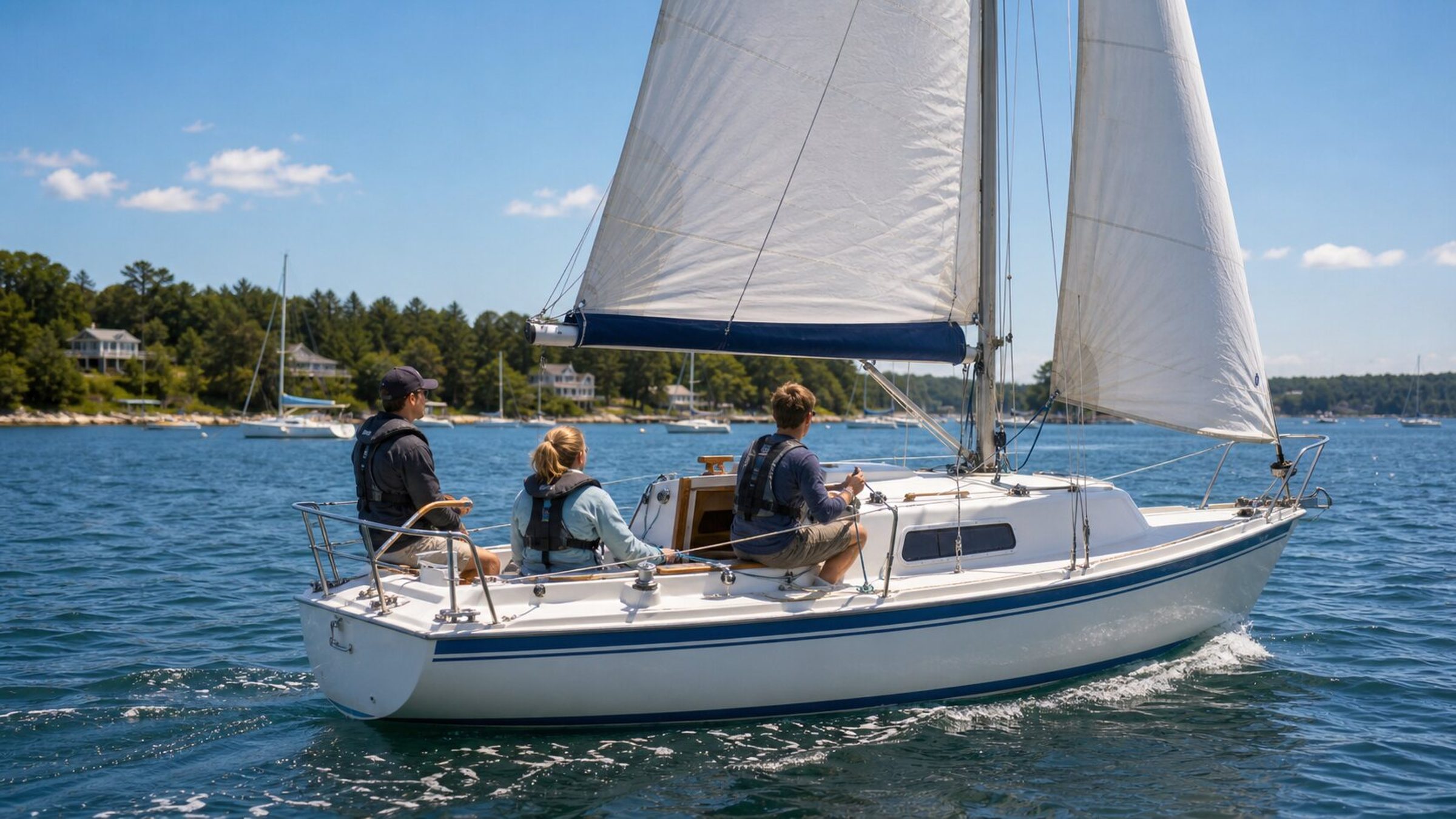
What makes a sailboat good for beginners
Not every boat marketed as "easy to sail" is actually a good first boat. Beginner forgiveness comes from specific design choices, and those choices are worth understanding before you start browsing listings.
Predictable helm feel. A beginner-friendly boat responds proportionally to steering inputs. It should track without constant correction and telegraph when it is becoming overpowered instead of snapping into a sudden heel. Mild weather helm is useful feedback. A violent, unpredictable helm is the warning sign.
A simple rig. The sail plan should be manageable by one or two people who are still learning, ideally with a furling headsail and a main that can be reefed without drama. Runners, overlapping sail inventories, unusual rigs, and deck layouts that require frequent foredeck work all ask for experience a first owner may not have yet. A masthead or fractional sloop with one headsail is the right starting point for most buyers.
Stability that buys you time. Higher ballast ratios — often around 38–44% on the most forgiving older cruisers — help the hull resist heel before demanding a response. A boat that stands up to puffs gives you time to think, ease the sheet, or reef. A tender boat with a low ballast ratio forces reactive sailing before you have built the instincts to manage it.
Standing headroom and real accommodations. A boat you can sleep, cook, and change clothes on is one you will use more. Boats you use more are boats you learn faster on. Short-term discomfort is manageable; an interior that makes every overnight feel like a crouching exercise becomes a structural reason not to go sailing.
A deep used market. The best beginner boat is one where the seller already has ten years of experience with it, where parts are readily available, where the surveyor has seen a dozen of them, and where the online forums have documented every common failure mode in detail. Resale liquidity also matters — if your needs change after a year, you want to be able to sell easily.
Research linkBrowse all beginner-friendly sailboats under 40 feetTop Beginner Sailboats
These are the models experienced sailors consistently recommend to beginners: boats with long production runs, active owner communities, and handling characteristics that reward new sailors instead of punishing them.
| Model ↕ | Listings ↓ | Year Built ↕ | LOA (ft) ↕ | Beam (ft) ↕ | Draft (ft) ↕ | Disp. (lbs) ↕ | Hull ↕ | Designer ↕ | Rig ↕ | Keel ↕ |
|---|---|---|---|---|---|---|---|---|---|---|
| Nauticat 33 | 83 for sale | 1967 | 33.17 ft | 10.67 ft | 5.08 ft | 17,250 lbs | Monohull | W. Aarnipalo | Ketch | Long |
| Island Packet 35 | 61 for sale | 1988 | 35.33 ft | 12 ft | 4.5 ft | 17,500 lbs | Monohull | Bob Johnson | Cutter | Long |
| Gozzard 36 | 28 for sale | 1985 | 36 ft | 12.5 ft | 4.75 ft | 18,150 lbs | Monohull | Ted Gozzard | Cutter | Fin |
| Rustler 36 | 23 for sale | 1980 | 35.33 ft | 11 ft | 5.5 ft | 16,805 lbs | Monohull | Holman & Pye | Masthead Sloop | Long |
| Cape Dory 30 C | 21 for sale | 1976 | 30.21 ft | 9 ft | 4.17 ft | 10,000 lbs | Monohull | Carl Alberg | Cutter | Full |
| Pacific Seacraft Dana 24 | 17 for sale | 1984 | 27.25 ft | 8.58 ft | 3.83 ft | 8,000 lbs | Monohull | William Crealock | Cutter | Long |
| Tradewind 35 | 16 for sale | 1975 | 35.01 ft | 10.5 ft | 5.51 ft | 19,442 lbs | Monohull | John Rock | Cutter | Long |
| Pearson 323 | 13 for sale | 1976 | 32.25 ft | 10 ft | 4.5 ft | 12,800 lbs | Monohull | William Shaw | Masthead Sloop | Fin |
| Pacific Seacraft Crealock 34 | 13 for sale | 1979 | 34.08 ft | 10 ft | 4.92 ft | 12,000 lbs | Monohull | William Crealock | Cutter | Long |
| Cape Dory 33 | 12 for sale | 1980 | 33.04 ft | 10.25 ft | 4.83 ft | 13,300 lbs | Monohull | Carl Alberg | Masthead Sloop | Long |
| Nauticat 331 | 12 for sale | 1997 | 33.14 ft | 11.15 ft | 4.86 ft | 18,739 lbs | Monohull | — | Ketch | Fin |
| Seastream 34 | 12 for sale | 1978 | 34 ft | 11 ft | 6.23 ft | 15,000 lbs | Monohull | Ian Anderson | Ketch | Fin |
| Vancouver 34 Classic | 12 for sale | 1991 | 34.25 ft | 10.5 ft | 4.75 ft | 14,000 lbs | Monohull | Robert B Harris | Cutter | Long |
| Nauticat 35 | 12 for sale | 1986 | 34.92 ft | 11.33 ft | 0 | 16,500 lbs | Monohull | Kaj Gustafsson | Masthead Sloop | Long |
| Cape George 36 | 10 for sale | 1979 | 36 ft | 10.5 ft | 5 ft | 23,300 lbs | Monohull | William Atkin/Ed Monk | Cutter | Long |
| Fisher 34 MS | 9 for sale | 1978 | 34.33 ft | 11.22 ft | 4.89 ft | 25,759 lbs | Monohull | Wyatt and Freeman | Ketch | Long |
| Hans Christian 33 | 8 for sale | 1980 | 32.75 ft | 11.67 ft | 5.5 ft | 18,500 lbs | Monohull | Harwood Ives | Cutter | Long |
| Tradewind 33 | 8 for sale | 1976 | 33 ft | 10.5 ft | 5.58 ft | 19,500 lbs | Monohull | John Rock | Masthead Sloop | Long |
| Sea Sprite 34 | 8 for sale | 1980 | 33.84 ft | 10.25 ft | 5 ft | 12,800 lbs | Monohull | A. E. Luders | Fractional Sloop | Long |
| Bowman 36 | 8 for sale | 1970 | 36 ft | 11.33 ft | 5.67 ft | 19,500 lbs | Monohull | Holman & Pye | Ketch | Long |
| Ericson 36 C | 7 for sale | 1975 | 36 ft | 12 ft | 5 ft | 17,200 lbs | Monohull | Bruce King | Cutter | Fin |
| Pacific Seacraft Orion 27-2 | 6 for sale | 1981 | 30.92 ft | 9.25 ft | 4 ft | 10,000 lbs | Monohull | Henry Mohrschladt | Cutter | Long |
| Beneteau Evasion 32 | 6 for sale | 1973 | 31.82 ft | 9.84 ft | 4.58 ft | 12,676 lbs | Monohull | André Bénéteau | Ketch | Long |
| Cutlass 27 | 5 for sale | 1967 | 27 ft | 7.67 ft | 4.5 ft | 6,496 lbs | Monohull | Eric White & Alan Hill | Masthead Sloop | Long |
| Contest 29 | 5 for sale | 1964 | 29 ft | 8.25 ft | 4.25 ft | 8,500 lbs | Monohull | G. Luyten | Masthead Sloop | Fin |
| Finnsailer 34 | 5 for sale | 1978 | 34.38 ft | 11.32 ft | 5.18 ft | 14,771 lbs | Monohull | Hans Groop | Masthead Sloop | Fin |
| International 600 | 5 for sale | 1965 | 36 ft | 10 ft | 5 ft | 15,000 lbs | Monohull | Robert G. Henry Jr. | Yawl | Long |
| Vancouver 32 | 4 for sale | 1986 | 32 ft | 10.58 ft | 4.5 ft | 14,000 lbs | Monohull | Robert Harris | Cutter | Long |
| Grampian 34 | 4 for sale | 1972 | 33.58 ft | 10 ft | 5 ft | 12,000 lbs | Monohull | Charles Angle/Axel Schmidt | Ketch | Fin |
| Tahiti Ketch | 3 for sale | 1928 | 30 ft | 10 ft | 4.36 ft | 18,000 lbs | Monohull | John G. Hanna | Ketch | Long |
| Falmouth Cutter 22 | 3 for sale | 1980 | 30.5 ft | 8 ft | 3.5 ft | 7,400 lbs | Monohull | Lyle Hess | Cutter | Long |
| Pacific Seacraft Orion 27 | 3 for sale | 1979 | 30.92 ft | 9.25 ft | 4 ft | 10,000 lbs | Monohull | Henry Mohrschladt | Cutter | Long |
| Contest 32 CS | 3 for sale | 1978 | 31.82 ft | 10.89 ft | 5.25 ft | 14,300 lbs | Monohull | Dick Zaal | Masthead Sloop | Fin |
| Barbary 32 | 3 for sale | 1970 | 32.5 ft | 10.33 ft | 4.75 ft | 14,200 lbs | Monohull | Walter F. Rayner | Ketch | Long |
| Cheoy Lee Clipper 33 | 3 for sale | 1970 | 32.92 ft | 10 ft | 4 ft | 12,000 lbs | Monohull | A. E. Luders | Ketch | Long |
| Najad 343 | 3 for sale | 1981 | 33.46 ft | 10.93 ft | 5.41 ft | 14,330 lbs | Monohull | Thorwald Karlsson | Masthead Sloop | Fin |
| Vancouver 34 Pilot | 3 for sale | 1994 | 34.25 ft | 10.5 ft | 4.75 ft | 14,000 lbs | Monohull | Robert B Harris | Cutter | Long |
| Contest 36 | 3 for sale | 1974 | 35.92 ft | 11.15 ft | 4.92 ft | 17,857 lbs | Monohull | Dick Zaal | Masthead Sloop | Fin |
| Vancouver 36 | 3 for sale | 1989 | 36 ft | 11 ft | 5 ft | 20,494 lbs | Monohull | Tony Taylore | Cutter | Long |
| Allied Seawind Mk II Ketch | 2 for sale | 1975 | 31.58 ft | 10.42 ft | 4.5 ft | 14,900 lbs | Monohull | Thomas Gillmer | Ketch | Long |
| Nauticat 321 | 2 for sale | 1999 | 32.81 ft | 10.63 ft | 5.41 ft | 13,228 lbs | Monohull | — | Masthead Sloop | Fin |
| Alajuela 33 | 2 for sale | 1977 | 33 ft | 10.67 ft | 4.75 ft | 13,500 lbs | Monohull | Raymond Richards | Cutter | Fin |
| Cape Dory 330 | 2 for sale | 1985 | 33.04 ft | 10.25 ft | 4.83 ft | 13,300 lbs | Monohull | Carl Alberg | Cutter | Long |
| Hans Christian 34 | 2 for sale | 1974 | 34 ft | 11 ft | 5.83 ft | 19,400 lbs | Monohull | Robert Perry | Cutter | Long |
| Mariner 36 | 2 for sale | 1972 | 35.83 ft | 11 ft | 5 ft | 21,000 lbs | Monohull | Clair Oberly/W. Garden | Ketch | Long |
| Allied Princess 36 | 2 for sale | 1972 | 36 ft | 11 ft | 4.5 ft | 14,400 lbs | Monohull | Arthur Edmunds | Ketch | Long |
| Allied Seawind | 1 for sale | 1962 | 30.5 ft | 9.25 ft | 4.5 ft | 12,000 lbs | Monohull | Thomas Gillmer | Ketch | Long |
| Cheoy Lee Offshore 33 | 1 for sale | 1971 | 32.92 ft | 10.16 ft | 3.67 ft | 12,480 lbs | Monohull | — | Ketch | Long |
| Trintella Iii | 1 for sale | 1969 | 35.24 ft | 10.5 ft | 4.59 ft | 16,535 lbs | Monohull | E.G. van de Stadt | Ketch | Long |
The benchmark: Catalina 36
Any conversation about the best beginner sailboat for a buyer who wants to do real sailing — weekend cruising, coastal passages, the occasional overnight — starts with the Catalina 36. With 1,766 hulls produced and deep used-market representation in this collection, it is one of the most available cruising keelboats in the 35–40 foot range. That matters because availability lowers search friction, gives surveyors familiar failure modes to inspect, and makes resale less mysterious.
The numbers explain the boat's enduring appeal. At 36.3 feet with a 44.4% ballast-to-displacement ratio, the 36 is unusually stiff for a production cruiser in this size range. It stands up to breeze with confidence, gives beginners time to react when conditions deteriorate, and tracks predictably without constant helm correction. The masthead sloop rig is about as simple as keelboat sailing gets: one headsail, one main, and a deck layout that can be organized for short-handed sailing. The 6'4" of headroom in the main cabin matches boats several feet longer, and the common Atomic 4 and Universal diesel installations are among the most thoroughly documented engines in the owner community.
The used market breaks into two Mark versions — the Mark I (1982–1996) and the improved Mark II (1996–present) — with incremental improvements to the cockpit, interior, and chainplate design. The Mark II's upgrades to the chainplate bulkheads address the most common structural concern on older examples, and it's the version most surveyors prefer. That said, a well-maintained Mark I is an excellent boat; the sailing character is the same.
The Catalina 34 is the natural smaller sibling: 1,438 hulls, similar sailing character, and a slightly easier ownership footprint. For a first-time buyer choosing between the two, the 34 is easier to dock and cheaper to berth; the 36 gives you more headroom, tankage, and cockpit confidence for longer weekends.
Research linkBrowse Catalina sailboats 30–40 feetThe step up: Catalina 350
The Catalina 350 occupies a different position than the 36 in the Catalina lineup. It is a more modern Gerry Douglas design, launched in 2003, with a wider beam, a more contemporary interior, and a fractional rig that improves light-air performance over the older masthead boats.
At 35.4 feet with 12,937 lbs of displacement and a 39.7% ballast ratio, the 350 is lighter and quicker than the 36, which translates to better performance in the sub-10-knot conditions that characterize most coastal sailing days. The interior is noticeably more modern: 6'9" of headroom, 88 gallons of water capacity, and an L-shaped galley that functions well underway. The 30 HP Yanmar engine and 39-gallon fuel tank give it real range under power for harbor entries and calm-weather passages.
The 350 sits a tier above the older Catalinas in both fit-out and budget. It is worth the premium for buyers who want a boat that feels like a twenty-first-century cruiser rather than an updated 1980s platform. The fractional rig and wider beam make it more rewarding in light air; the larger water tank and head arrangement make extended coastal weekends easier to live with.
The Hunter alternative
Hunter Marine built its lineup around the same practical premise as Catalina — maximum usable boat at an accessible price — but leaned harder into wide beam, open interiors, and modern hull forms. The result is a family of boats that prioritize interior comfort and initial stability, often at the expense of ultimate sailing performance.
The Hunter 34, designed by Cortland Steck and produced in the mid-1980s, earns its "lot of boat for the money" reputation honestly. The broad beam creates a saloon that feels closer to a 38-footer than a 34, and the simple masthead sloop rig is as approachable as sailboat rigs get. Hunter's later B&R rigs eliminate the backstay, opening up the cockpit and allowing a larger-roach mainsail, but they require a slightly different tuning mindset than a conventional rig. For a beginner, the practical takeaway is simple: buy the better-maintained boat and learn the rig you have.
The Hunter 33.5 is worth knowing as a close neighbor: a comfortable coastal cruiser with similar interior volume and the same Hunter philosophy of ease-first design. Both models tend to reward buyers who prioritize condition, ventilation, and deck-core health over small differences in published performance ratios.
What to watch on older Hunters: The chainplate design on 1980s and early 1990s models routes through the deck in ways that invite moisture intrusion. On any used Hunter from this era, a focused survey of the chainplate bulkheads and deck coring around hardware penetrations is essential. These are well-understood, well-documented issues with established repair protocols — not disqualifiers, but non-negotiables.
Research linkBrowse Hunter sailboats under 40 feetThe European option: Beneteau Oceanis
The Beneteau Oceanis line is the European answer to the Catalina/Hunter formula: volume-optimized, comfort-first cruising sailboats built for coastal sailing, charter fleets, and private owners who want modern ergonomics. Where the American builders leaned on familiarity and simplicity, Beneteau brought contemporary naval architecture, light interiors, and rigs that usually feel livelier in moderate air.
The Beneteau Oceanis 35.1 is the relevant modern reference point for a beginner looking for something newer. At 34.3 feet with 13,153 lbs of displacement, 6'3" of headroom, and a fractional rig with a self-tacking jib option, it packages a contemporary sailing experience into a size a couple can manage without difficulty.
For buyers who want the Beneteau experience at lower cost, older Oceanis models in the 36–38 foot range offer similar sailing character at lower entry prices. The Oceanis 36, 37, and 381 all share the builder's emphasis on ergonomics, light interiors, and rigs that reward more active sail trim than the heavier American designs.
The Beneteau Oceanis 34.1 is the newest expression of that idea in this list. At 35.3 feet and 12,059 lbs with a bulb keel and a fractional rig, it packages the contemporary Beneteau experience — self-tacking jib option, twin rudders, and 6'3" headroom — into a size a couple can handle without stepping into big-boat systems.
The honest trade-off with Beneteau is weight distribution. Lighter hulls and iron ballast on many models often mean lower ballast ratios than the heavier American production boats. The result is a livelier, more responsive boat that asks for more active steering in a seaway. For a beginner who values sailing feel, this can be a virtue; for one who wants maximum forgiveness, the heavier Catalinas are more tolerant.
Research linkBrowse Beneteau Oceanis sailboatsThe current-production option: Jeanneau Sun Odyssey 350
If your budget reaches new-boat territory, the Jeanneau Sun Odyssey 350 is the most deliberately beginner-oriented modern design here. Jeanneau built the Sun Odyssey 350 around a walk-around deck — side decks that slope down into the cockpit with fewer obstacles underfoot — specifically to make moving around the boat under sail feel safer to people who are still building their sea legs.
At 34.1 feet and 12,469 lbs with a fractional rig and a self-tacking jib option, it sails like a modern boat: responsive, light on the helm, and easy to short-hand. The trade-off is the same one that applies to many newer European cruisers: a lower ballast ratio than the old American standards, which means more responsiveness and less passive forgiveness. For a beginner who can stretch to the price, the ergonomics and deck layout are confidence-building in a way older designs rarely are.
The under-30 foot starting point
Not every beginner needs or wants a 35-footer. The case for starting smaller is real: lower purchase price, lower slip fees, easier to maneuver, simpler systems, and the confidence-building experience of a boat that responds immediately to your inputs.
The Catalina 30 is the standard bearer here. With over 6,400 hulls built between 1974 and 2008, it is one of the deepest used-market choices in American sailing. At 29.9 feet with 6'2" of headroom and a 41% ballast ratio, it delivers the interior volume of a 1970s 34-footer and the stability of a properly weighted keelboat. It is the boat more beginner sailors have learned on than any other in its size range, and the Catalina 30 International Association maintains a technical archive that answers virtually every question a new owner will have.
The Catalina 27 steps down another rung: 6,600 hulls, enough boat for a weekend with a partner, and a much simpler ownership footprint. For buyers whose primary goal is to learn to sail rather than immediately cruise, the 27 is often the right choice. It is small enough to feel every sail-trim decision, big enough to sleep and cook aboard, and common enough that the learning curve is supported by decades of owner notes.
Comparison: the key numbers
The ballast ratio column tells much of the story about how forgiving a boat will feel. Higher ratios usually mean more resistance to heel and more time to react before the boat asks for a reef. The comfort ratio is about motion: higher numbers tend to mean a slower, less abrupt ride in a seaway, which matters on any passage longer than a day sail.
| Model | LOA | Displacement | Ballast Ratio | Headroom | Listings | Median Price |
|---|---|---|---|---|---|---|
| Catalina 27 | 27 ft | 6,850 lbs | ~37% | 6'1" | Many | ~$10,000 |
| Catalina 30 | 29.9 ft | 10,200 lbs | ~41% | 6'2" | 169 | ~$18,000 |
| Catalina 34 | 34.5 ft | 11,950 lbs | 41.8% | 6'2" | 101 | ~$40,000 |
| Hunter 34 | 34 ft | ~10,000 lbs | ~38% | 6'2" | Multiple | ~$25,000 |
| Catalina 36 | 36.3 ft | 13,500 lbs | 44.4% | 6'4" | 169 | ~$56,000 |
| Catalina 350 | 35.4 ft | 12,937 lbs | 39.7% | 6'9" | 64 | ~$99,000 |
| Beneteau Oceanis 35.1 | 34.3 ft | 13,153 lbs | 26.1% | 6'3" | 38 | ~$172,000 |
What the community gives you
The practical value of choosing a popular model is hard to overstate. When your Catalina 36's raw-water impeller fails at 6 pm on a Friday, the answer is probably already in an owners' forum, often with photos and part numbers. When you are trying to understand why the boat develops weather helm above 18 knots, other owners have almost certainly worked through the same question and shared the sail-trim or rig-tuning fix.
This is the asset that popular production boats offer that a custom design or a rare model simply cannot. The Catalina and Hunter owners' associations, the Beneteau and Jeanneau Facebook groups, and the general forums on Sailing Anarchy and Cruisers Forum have accumulated decades of practical knowledge about the most common models. For a beginner, that institutional knowledge is often more valuable than any other feature the boat offers.
The corollary: buying an unusual boat as a first sailboat is a mistake even experienced sailors make. A beautiful 1970s Dutch sloop at a bargain price can require you to solve every problem from first principles because no large community has already solved it. A Catalina 36 usually requires you to find the thread where someone else already did the work, which is a much more manageable task while you are still learning.
The survey is not optional
Every used sailboat — regardless of model, price, or condition — should be professionally surveyed before purchase. This is true at $10,000 and true at $150,000. Survey costs vary by region and scope, but they are usually small compared with the cost of discovering wet core, tired standing rigging, or engine problems after closing.
For each model above, there are specific items that deserve survey focus:
- Catalina 36: Chainplate bulkheads on Mark I boats, compression post base under the mast, keel attachment bolts
- Catalina 34/350: Same chainplate concerns, standing rigging (replace if over 10 years old)
- Hunter 34/33.5: Deck-stepped mast compression zone, chainplate moisture intrusion, balsa deck coring around hardware
- Beneteau Oceanis: Foam core integrity in the deck, osmotic blistering on older hulls, rudder bearing play
None of these are exotic problems. They are expected wear points on older fiberglass production boats, well-documented in owner communities and familiar to experienced surveyors. The goal is to know what you are buying and price the work accordingly — not to find a boat with no issues, because that boat does not exist in this market.
Shopping by budget
Under $25,000 — Catalina 22s, Catalina 27s, older Catalina 30s, and comparable Hunter and Pearson models from the 1970s and 1980s. These are fundamentally sound designs with old-boat maintenance realities. Keep reserve money for standing rigging, running rigging, sails, bottom work, safety gear, and the cosmetic repairs every inexpensive boat seems to need.
Research linkBrowse sailboats under $25,000$25,000–$75,000 — The heart of the beginner cruiser market. Better-condition Catalina 30s, Catalina 34s, Hunter 34s, and earlier Catalina 36s live here. Boats in this range may still need sails, running rigging, electronics, or canvas, but they should be structurally sound and close to usable.
Research linkBrowse sailboats $25,000–$75,000$75,000–$175,000 — Better-equipped Catalina 36s, Catalina 350s, and late-model Beneteau Oceanis boats. In this range you should expect a recent survey or survey-ready condition, documented maintenance history, updated electronics, and a boat you can provision and sail soon after purchase.
Research linkBrowse sailboats $75,000–$175,000Refine your search
These filters map the buying advice above to concrete search constraints: stability, size, and keel type.
By stability:
Research linkWell-ballasted hulls (ballast ratio 38%+)Research linkConservative capsize screening (ratio under 2.0)By size:
Research linkStarter boats under 30 feetResearch linkStep-up cruisers 30–40 feetBy keel type:
Research linkFixed fin keel only (simplest to own)Research linkCenterboard and swing keel trailerable designs