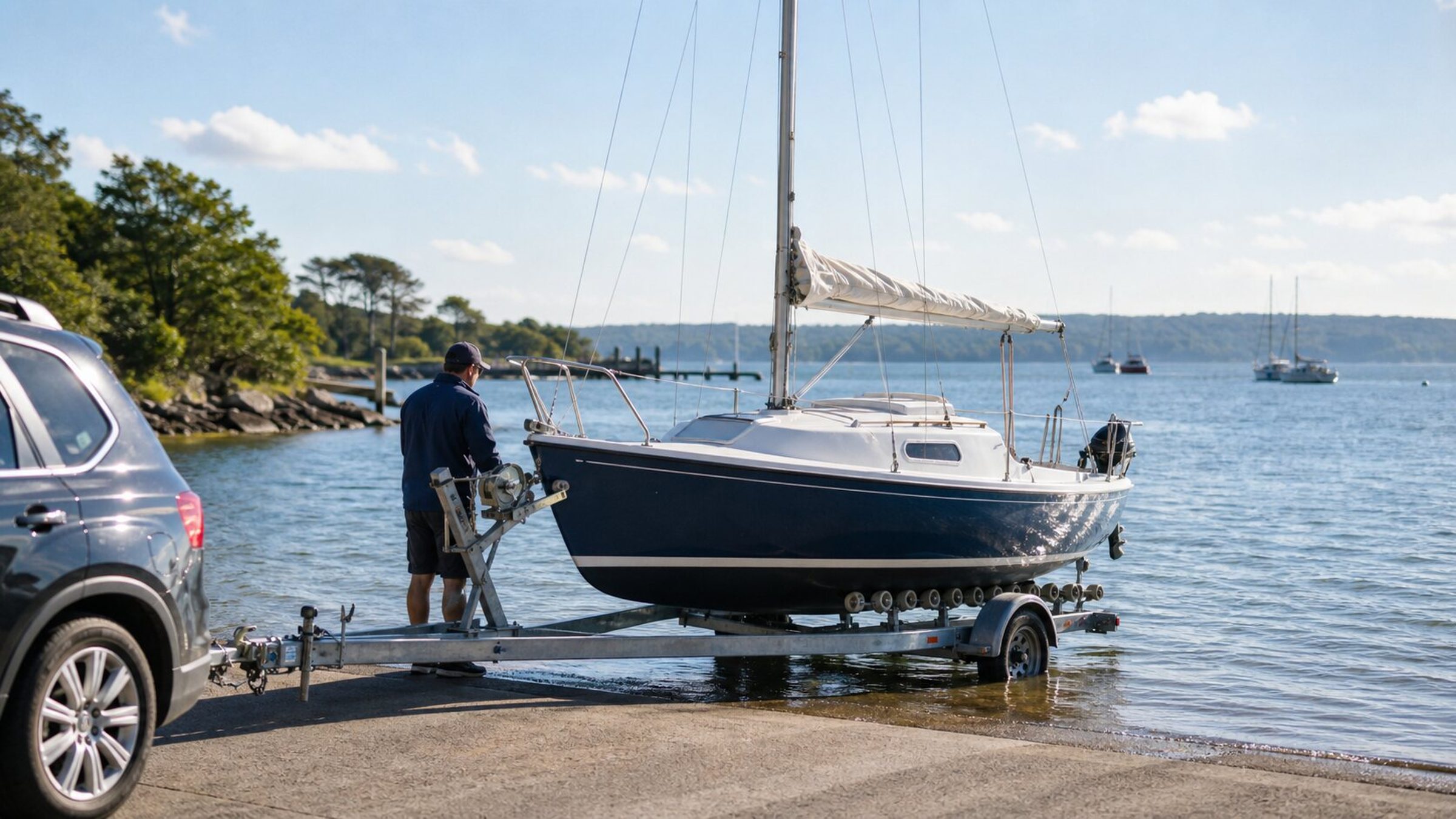
Before you shop for a trailerable sailboat, look at your tow vehicle. Everything downstream flows from that number. A half-ton pickup can tow a wide range of boats depending on engine, axle ratio, brakes, and payload, but the critical figure is gross trailer weight: hull, rig, trailer, outboard, fuel, water, gear, and weekend supplies together. For most trailer sailers in the 22–26 ft range, plan on a combined tow weight well above the published displacement. A family SUV with a tow package handles the smaller end; heavier pocket cruisers call for a proper truck and a disciplined loading plan.
Tow capacity is not a footnote. It defines which boats belong in your search before LOA, price, or cabin layout do.
What Makes a Sailboat Truly Trailerable
Trailerability means more than "fits on a trailer." It means you can realistically de-rig, load, tow, and relaunch without a crew of four or a dedicated yard team. The practical checklist:
- LOA under 26 feet. State permit requirements, ramp geometry, and standard trailer dimensions converge here. Boats over 26 ft become harder to launch casually and may trigger extra transport rules depending on beam.
- Displacement under 4,000 lbs. Above this threshold, you are in serious truck territory and ramp handling becomes much harder solo.
- Retractable or folding underbody. A centerboard, swing keel, lifting keel, or — for trimarans — a folding aka system that brings beam down to the legal 8 ft 6 in width. Fixed-keel monohull designs over 18 inches of draft become awkward on most ramps.
- Tabernacle or deck-stepped mast. A mast you can raise and lower without a crane keeps you out of expensive boatyards every spring and fall.
This guide covers boats with a real cabin or at least meaningful shelter: vessels where you can sleep aboard, cook a simple meal, and get out of weather. That includes obvious pocket-cruiser monohulls, modern lightweight European designs, and the folding trimarans that occupy the same trailerable footprint while sailing much faster. Most trailerable lists skip the third category. They should not.
The Benchmark: Catalina 22
If you want to understand the trailerable-cruiser market, start with the Catalina 22. Frank Butler launched it in 1969, and with more than 15,000 hulls built across more than 50 years of production, it is the benchmark American trailer sailer. Every competitor in this segment has been measured against it.
The standard Catalina 22 carries a swing keel weighing roughly 550 lbs, which winches up into a fiberglass trunk for trailering. Board up, draft is 2 feet. Board down, it is 5 feet, enough for respectable upwind work in a breeze. The signature feature is the pop-top cabin: a hinged section of cabin roof that lifts at anchor, providing more than 6 feet of headroom on a boat that still trailers at legal road width.
The Catalina 22 is tender above 15 knots, and the swing-keel mechanism needs periodic attention. The pivot pin wears, the lifting cable deserves inspection every season, and the winch should operate smoothly. But the boat is forgiving, widely supported by one of sailing's most active owner associations, and common enough that you can learn what to inspect before you buy.
It remains the yardstick. Modern monohull, classic pocket cruiser, or folding trimaran, every boat below gets compared to the Catalina 22's mix of access, support, and simplicity.
Comparing the Field
The table below covers the strongest trailer sailer candidates across the category's three lanes: legacy monohulls, modern monohulls, and folding trimarans. Treat displacement as the starting point for towing math, not the finished number.
| Boat | LOA | Hull | Displacement | Draft (up/down) | Years | Best For |
|---|---|---|---|---|---|---|
| Catalina 22 | 22 ft | Monohull | 2,250 lbs | 2 / 5 ft | 1969–present | All-around starter |
| MacGregor 26M | 26 ft | Monohull | 2,350 lbs* | 1 / 4 ft | 2003–2013 | Solo trailering, water-ballast |
| Com-Pac 23 | 23 ft | Monohull | 3,000 lbs | 2 ft 3 in | 1979–present | Coastal cruising, stability |
| Precision 23 | 23 ft | Monohull | 2,450 lbs | 1 ft 11 in / 5 ft 3 in | 1986–2018 | Performance + weekend cruising |
| Hunter 23.5 | 23.7 ft | Monohull | ~3,200 lbs | 1 ft 9 in | 1990s | Interior volume, lake sailing |
| O'Day 22 | 21.7 ft | Monohull | 2,200 lbs | 1.5 / 4 ft | 1972–1984 | Families, easy sailing |
| Montgomery 17 | 17 ft | Monohull | 1,400 lbs | 2 ft | 1968–present | Solo micro-cruising |
| Viko 21 | 21 ft | Monohull | 2,094 lbs | varies | 2015–present | Modern, sub-€25k cabin cruiser |
| Pointer 22 | 21.3 ft | Monohull | 1,653 lbs | varies | 2017–present | Modern Dutch daysailer-cruiser |
| Corsair F-24 | 24 ft | Trimaran | 1,800 lbs | 1 / 5 ft | 1992–1994 | Folding tri performance classic |
| Corsair Dash 750 | 24.3 ft | Trimaran | 1,870 lbs | 1 / 5 ft | 2006–present | Modern Corsair with cabin |
| Dragonfly 25 | 25 ft | Trimaran | 2,315 lbs | 1.3 / 5.9 ft | 1981–present | Premium folding-aka cruising tri |
| Astus 20.2 | 19.5 ft | Trimaran | 770 lbs | 0.7 / 3.6 ft | 2010–2018 | Vestigial-cabin folding tri |
*MacGregor 26M displacement listed without water ballast. Filled, the tanks add ~900 lbs.
Boat-by-Boat: The Strong Monohull Contenders
MacGregor 26M and 26X — Best for Solo Trailering
The MacGregor 26M occupies a unique niche. Where most trailer sailers rely on heavy lead ballast for stability, the MacGregor 26 uses water ballast: large tanks in the bilge that are filled at the ramp and emptied before towing home. Empty, the boat weighs around 2,350 lbs. Filled, the water ballast adds roughly 900 lbs.
The trade-off is real: water ballast is less effective than lead per pound, so the MacGregor 26 requires more active sail management in chop. It is not the best trailerable boat for open-coast passages. But for solo sailors who want to cover ground on the highway, sail a new lake every month, and avoid a heavy tow rig, there is nothing else quite like it in this size range. The 26X added a more powerful outboard well and a different interior layout.
Precision 23 — Best Performance Trailerable
The Precision 23 is the non-obvious monohull pick in this roundup: a boat many shoppers overlook because it does not carry a Catalina or Hunter badge, yet it routinely surprises sailors who step aboard.
Naval architect Jim Taylor gave it a lead-ballasted stub keel paired with a fiberglass centerboard, a setup that places ballast lower than a pure swing-keel design while still allowing the board to retract for trailering. Draft board-up is 1 foot 11 inches; board down, 5 feet 3 inches. The result is a boat with a sail-area-to-displacement ratio around 22, which makes it genuinely lively in light air. That cannot be said about many heavier trailerable cruisers.
Inside, Taylor eliminated the traditional mast compression post by integrating a reinforced overhead beam into the structure. This creates an unusually open cabin for a 23-footer. The Precision 23 sleeps four, carries a compact galley, and has enough capability for ambitious coastal work in the hands of owners who understand its limits.
Com-Pac 23 — Best for Coastal Cruising
The Com-Pac 23 takes a different approach to the category. Where most trailer sailers optimize for light weight, the Com-Pac 23 is deliberately heavy, with substantial encapsulated lead ballast. The resulting stability is exceptional for a 23-footer.
The fixed shoal keel draws only 2 feet 3 inches and avoids the mechanical complexity of swing-keel systems entirely: no cable, no pivot pin, no keel clunk. Builder The Hutchins Company calls this the "little ship" philosophy, and it shows. The Com-Pac 23 has solid fiberglass construction, bronze deck hardware, and a teak-trimmed interior that feels more traditional than most boats its size. The downside is tow weight and light-air speed; a heavy trailerable asks more of the tow vehicle and less readily accelerates below about 8 knots of wind.
Hunter 23.5 — Best Interior Volume
The Hunter 23.5 uses water ballast like the MacGregor but applies it to a different purpose: maximizing interior volume for a given tow weight. The result is a boat with a beam approaching 8 feet and a cabin that families find genuinely livable for a weekend.
The 23.5 is not a performance boat. It was designed for sailors who want comfortable, low-anxiety sailing on protected waters and overnight accommodations they can stand up in. The water-ballast system keeps road weight down when the tanks are empty, but it also asks for realistic expectations under sail.
O'Day 22 — Best Family Starter
C. Raymond Hunt designed the O'Day 22 in 1972, and over 3,000 were built. The centerboard trunk runs through the cabin, but the board retracts flush for trailering, leaving just over 18 inches of draft. The boat is known for being exceptionally forgiving. It will not bite inexperienced crews, and the build quality has proven robust enough that examples from the 1970s still sail actively today.
For a family putting children on a keelboat for the first time, or a sailor returning to the water after years ashore, the O'Day 22 is one of the best small sailboats to trailer for sheer approachability.
Montgomery 17 — Best Micro-Cruiser
Lyle Hess designed the Montgomery 17 with the same philosophy he brought to his larger cruisers: heavy ballast-to-displacement ratio, conservative freeboard, and genuine seakeeping at the expense of speed. At 17 feet and 1,400 lbs, it is the smallest true cruiser on this list.
The fixed shoal keel draws 2 feet and the boat carries 700 lbs of ballast, a 50% ratio that is extraordinary for the size. Owners have completed coastal passages that would make lighter 22-footers feel overmatched. The Montgomery 17 trims to a single-axle trailer and sits at the manageable end of trailer sailing.
Modern Trailerable Monohulls
The trailerable monohull category looked frozen in the 1990s for a long time. It is not anymore. European builders have spent the last decade modernizing the formula with chined hulls, fractional rigs, and contemporary interior volume at prices that can compete with clean U.S. legacy boats. Two of them deserve attention.
Viko 21 — Best Modern Monohull
The Viko 21 (often badged S21) is one of the most under-recognized boats in this category. Polish builder Navikom commissioned Italian designer Sergio Lupoli for the design, which carries a pronounced chined hull, a fractional rig, and a low-profile coachroof that does not look like anything from 1985.
The keel options are unusual for the price: a swing keel for shallow water, a lifting keel with a lead bulb for performance, or a fixed shoal keel for coastal use. The chined hull gives it real form stability when pressed, important because the boat is light and would otherwise feel tender. Sailors moving from open daysailers find it familiar; sailors moving from heavy 1970s pocket cruisers may find it surprisingly responsive in a good way.
The interior is utilitarian rather than luxurious: minimalist joinery, compact systems, and limited headroom away from the companionway. But four berths, a small galley, and useful shelter are real achievements in a 21-footer.
Pointer 22 — Modern Dutch Daysailer-Cruiser
The Pointer 22 is the harder-edged modern option. A Dutch design at 21.3 ft and 1,653 lbs, it is targeted at sailors who want a contemporary boat with a small cabin for the occasional overnight rather than a full pocket cruiser. The build quality is high, the rig is modern fractional, and U.S. availability is more limited than the legacy American boats.
If you want the modern aesthetic without the volume-first brief of a Viko, the Pointer is the cleaner answer.
Trailerable Trimarans — The Category Most Lists Miss
A folding trimaran solves the same problem as a swing-keel monohull from the opposite direction. Instead of retracting underwater appendages to fit on a trailer, the amas fold against the main hull, dropping beam from 17–18 ft under sail to legal road width. The result is a boat that trailers like a 24-footer but sails like a small multihull: much faster than a monohull of the same length, with very little heel.
Three trimarans dominate the trailerable cruising-tri segment: the Corsair F-24, the Corsair Dash 750, and the Dragonfly 25. Astus fills the smaller, lighter end of the same idea.
Corsair Dash 750 — Best Modern Folding Trimaran
The Corsair Dash 750 is the modern answer for sailors who want a trailerable trimaran with a real cabin. Built on proven F-24 thinking but with a redesigned deck and a more livable interior, it resets expectations for what "trailerable cruising" can mean if you are willing to step off the monohull track.
The performance is genuinely different. With a wide sailing beam, a square-top mainsail, a roller-furling jib, and a screecher on a retractable carbon bowsprit, the Dash 750 can reach double-digit speeds and often feels effortless in moderate air. It heels far less than any monohull on this list, reducing crew fatigue and making the boat less intimidating to non-sailing family members.
The cabin is "luxury camping" rather than yacht-style cruising: a V-berth forward, two settees in the main salon, a pop-top companionway for standing headroom at anchor, and rudimentary galley provisions. That is enough for weekends on the boat, not enough for liveaboard comfort.
Inspect the folding aka mechanism, including stainless pivot bolts and aluminum struts, plus the daggerboard trunk for impact damage and the rudder kick-up assembly for wear. Trailer condition is part of the boat's value because many Dash 750s spend significant time on the road.
Corsair F-24 — The Classic Folding Trimaran
The Corsair F-24 is the boat that made trailerable trimarans mainstream. Ian Farrier designed it in the early 1990s as an accessible alternative to his groundbreaking F-27, and the patented Farrier Folding System became the industry standard. It folds from nearly 18 feet of sailing beam to road-legal width in minutes once the owner knows the sequence.
What you get with the older design is much of the same on-water experience as a Dash 750 with a less refined interior: speed potential, shallow-water capability, and minimal heel. The F-24 won Sailing World's Sportboat of the Year shortly after launch and remains a fixture in events like the Texas 200.
Dragonfly 25 — The Premium Cruising Tri
The Dragonfly 25 is the premium alternative: a Danish-built trimaran from Quorning Boats, with the Swing-Wing folding system and a build quality that justifies a price premium over most Corsair examples. The model has existed across multiple generations, with later versions refining the same folding-cruising idea.
Dragonflies are not the typical pick for a budget trailer sailor. They are frequently the most expensive boat in any pocket-cruiser comparison. But the design pedigree is serious, and buyers who value premium construction may prefer the Quorning approach to the harder-used secondary-market Corsair examples.
Astus 20.2 — The Compact Folding Tri
The Astus 20.2 is the compact entry to folding-tri cruising. French builder Astus put a vestigial cabin on a 19.5 ft folding trimaran, keeping the boat light enough for easy towing. It is small — sleep two in real space, with awkward overnighting beyond that — but it folds, it tows behind an appropriate SUV, and it sails like a trimaran.
The Specs Table
Browse full specs including sail area, rig dimensions, and the collection table below.
| Model ↕ | Listings ↓ | Year Built ↕ | LOA (ft) ↕ | Beam (ft) ↕ | Draft (ft) ↕ | Disp. (lbs) ↕ | Hull ↕ | Designer ↕ | Rig ↕ | Keel ↕ |
|---|---|---|---|---|---|---|---|---|---|---|
| Catalina 22 | 47 for sale | 1969 | 23.83 ft | 7.67 ft | 5 ft | 2,250 lbs | Monohull | Frank V. Butler | Masthead Sloop | Wing |
| Catalina 25 | 44 for sale | 1976 | 25 ft | 8 ft | 4 ft | 4,550 lbs | Monohull | Frank Butler | Masthead Sloop | Fin |
| Catalina 22 Mk II | 15 for sale | 1995 | 23.83 ft | 7.66 ft | 3.5 ft | 2,490 lbs | Monohull | Frank V. Butler | Masthead Sloop | Fin |
| Jeanneau Tonic 23 | 13 for sale | 1985 | 23.94 ft | 8.2 ft | 2.3 ft | 2,866 lbs | Monohull | Philippe Harle | Fractional Sloop | Fin |
| Rustler 24 | 8 for sale | 2010 | 24 ft | 6.25 ft | 3.42 ft | 3,615 lbs | Monohull | David Boyd/Rustler | Fractional Sloop | Long |
| Compromis 777 | 8 for sale | 1977 | 25.82 ft | 9.12 ft | 4.1 ft | 5,071 lbs | Monohull | Frans Maas | Masthead Sloop | Fin |
| LM 22 | 5 for sale | 1975 | 21.98 ft | 8.66 ft | 4.27 ft | 3,527 lbs | Monohull | Bent Juul Andersen | Masthead Sloop | Fin |
| Leisure 23 SL | 5 for sale | 1979 | 22.64 ft | 7.84 ft | 2.66 ft | 4,050 lbs | Monohull | Frank Pryor | Masthead Sloop | Twin |
| Independence 20 | 3 for sale | 1999 | 20.5 ft | 8 ft | 4 ft | 2,080 lbs | Monohull | Gary Mull | Fractional Sloop | Fin |
| Dehler Delanta 76 | 3 for sale | 1974 | 24.93 ft | 8.14 ft | 4.1 ft | 3,307 lbs | Monohull | E. G. van de Stadt | Masthead Sloop | Fin |
| Chrysler 26 | 3 for sale | 1977 | 25.98 ft | 8 ft | 6.17 ft | 5,000 lbs | Monohull | Halsey Hereshoff | Masthead Sloop | Wing |
| Sailart 19 | 2 for sale | 2016 | 20.67 ft | 8.2 ft | 4.27 ft | 1,742 lbs | Monohull | — | Fractional Sloop | Wing |
| Leisure 22 | 2 for sale | 1971 | 22 ft | 7.83 ft | 2.67 ft | 3,300 lbs | Monohull | Graham Craddick/Frank Pryor | Masthead Sloop | Twin |
| Marshall 22 Sloop | 2 for sale | 1965 | 22.18 ft | 10.18 ft | 5.18 ft | 5,660 lbs | Monohull | Breckenridge Marshall | Gaffhead Sloop | Centerboard |
| Tanzer 22 | 2 for sale | 1970 | 22.5 ft | 7.83 ft | 3.42 ft | 2,900 lbs | Monohull | Johann Tanzer | Masthead Sloop | Fin |
| Waarschip 730 | 2 for sale | 1977 | 23.95 ft | 9.51 ft | 4.1 ft | 3,307 lbs | Monohull | — | Masthead Sloop | Fin |
| Endeavour 24 | 2 for sale | 1966 | 24 ft | 7.83 ft | 3.5 ft | 3,307 lbs | Monohull | R. Gardner/L. Hedges/J. Bott | Masthead Sloop | Fin |
| Colvic Springtide 24 | 2 for sale | 1973 | 24.25 ft | 8 ft | 2.92 ft | 6,300 lbs | Monohull | Kenneth Evans | Masthead Sloop | Triple |
| Tanzer 7.5 | 2 for sale | 1977 | 24.58 ft | 8 ft | 4 ft | 3,800 lbs | Monohull | Johann Tanzer | Masthead Sloop | Fin |
| Sunbeam 25 | 2 for sale | 1993 | 25.26 ft | 8.14 ft | 4.1 ft | 3,638 lbs | Monohull | Manfred Schöchl | Fractional Sloop | Fin |
| Newbridge Pioneer 26 | 2 for sale | 1986 | 25.83 ft | 9 ft | 3 ft | 5,875 lbs | Monohull | Bill Dixon | Masthead Sloop | Twin |
| C&C 26 Encounter | 2 for sale | 1978 | 26 ft | 10 ft | 3.92 ft | 6,120 lbs | Monohull | C&C | Masthead Sloop | Fin |
| Waarschip 21 CR | 1 for sale | 2014 | 20.34 ft | 8.2 ft | 3.28 ft | 1,653 lbs | Monohull | Arthur Peltzer | Fractional Sloop | Fin |
| Waarschip 660 | 1 for sale | 1979 | 21.65 ft | 8.2 ft | 3.28 ft | 2,646 lbs | Monohull | K.T. Kremer | Fractional Sloop | Fin |
| Jeanneau Love Love | 1 for sale | 1971 | 21.7 ft | 8 ft | 3.4 ft | 2,650 lbs | Monohull | Philippe Harlé | Masthead Sloop | Fin |
| Tylercraft 22 | 1 for sale | 1960 | 22 ft | 7.16 ft | 2 ft | 3,200 lbs | Monohull | Ted Tyler | Masthead Sloop | Twin |
| Samphire 23 | 1 for sale | 1977 | 22.75 ft | 7.75 ft | 2.92 ft | 5,376 lbs | Monohull | David M. Cannell | Masthead Sloop | Long |
| Sunbeam 23 | 1 for sale | 1979 | 22.8 ft | 8.2 ft | 3.94 ft | 2,976 lbs | Monohull | Manfred Schöchl | Fractional Sloop | Bulb |
| Baycruiser 23 | 1 for sale | 2010 | 22.9 ft | 7.74 ft | 4.92 ft | 1,874 lbs | Monohull | — | Fractional Sloop | Centerboard |
| Mantra 7000 | 1 for sale | 1998 | 22.97 ft | 8.2 ft | 4.92 ft | 2,646 lbs | Monohull | Andrzej Arminski | Fractional Sloop | Fin |
| Sunbeam 24 | 1 for sale | 2002 | 22.97 ft | 8.2 ft | 0 | 3,527 lbs | Monohull | Georg Nissen | Fractional Sloop | Centerboard |
| Pearson 23 | 1 for sale | 1978 | 23 ft | 7.98 ft | 5.17 ft | 3,500 lbs | Monohull | William Shaw | Masthead Sloop | Centerboard |
| Virgo Voyager | 1 for sale | 1971 | 23 ft | 8.33 ft | 4 ft | 4,410 lbs | Monohull | Roy Lunney | Masthead Sloop | Fin |
| Grampian 23 | 1 for sale | 1971 | 23.25 ft | 8 ft | 5.33 ft | 3,200 lbs | Monohull | Alex McGruer | Masthead Sloop | Wing |
| Vivacity 24 | 1 for sale | 1969 | 23.5 ft | 8 ft | 3.67 ft | 4,200 lbs | Monohull | Alan Hill | Masthead Sloop | Fin |
| Balboa 24 | 1 for sale | 1981 | 23.58 ft | 8.33 ft | 2.92 ft | 2,600 lbs | Monohull | Shad Turner/William Downing | Fractional Sloop | Fin |
| Buccaneer 240 | 1 for sale | 1975 | 23.67 ft | 8 ft | 2.5 ft | 4,000 lbs | Monohull | Alan Payne/Bayliner | Masthead Sloop | Long |
| Seahorse 24 | 1 for sale | 1972 | 23.75 ft | 7.9 ft | 4.67 ft | 2,900 lbs | Monohull | Robert Finch | Masthead Sloop | Centerboard |
| Marauder 24 | 1 for sale | 1975 | 23.83 ft | 7.5 ft | 4.16 ft | 3,600 lbs | Monohull | Kevin Shepherd | Fractional Sloop | Fin |
| Eventide 24 | 1 for sale | 1957 | 24 ft | 8 ft | 2.75 ft | 4,000 lbs | Monohull | Maurice Griffiths | Cutter | Twin |
| Nimble Kodiak 24 | 1 for sale | 1998 | 24 ft | 8.5 ft | 4.33 ft | 4,100 lbs | Monohull | Ted Brewer | Masthead Sloop | Centerboard |
| Seaforth 24 | 1 for sale | 1977 | 24 ft | 7.33 ft | 2.5 ft | 4,200 lbs | Monohull | Stephen Seaton | Masthead Sloop | Long |
| Seaward 24 | 1 for sale | 1984 | 24 ft | 8 ft | 3.5 ft | 3,100 lbs | Monohull | Nick Hake | Fractional Sloop | Centerboard |
| Sailart 24 | 1 for sale | 2003 | 24.28 ft | 8.2 ft | 3.12 ft | 2,866 lbs | Monohull | — | Fractional Sloop | Wing |
| Balaton 24 | 1 for sale | 1966 | 24.44 ft | 7.55 ft | 3.94 ft | 4,189 lbs | Monohull | Gunnar Cardell | Masthead Sloop | Fin |
| Watkins 25 | 1 for sale | 1985 | 24.92 ft | 8.5 ft | 2.5 ft | 4,800 lbs | Monohull | — | Masthead Sloop | Fin |
| Victoire 25 | 1 for sale | 1967 | 25.16 ft | 8.2 ft | 3.75 ft | 4,180 lbs | Monohull | D. Koopmans Sr. | Masthead Sloop | Fin |
| Tanzer 25 | 1 for sale | 1986 | 25.25 ft | 9.58 ft | 4.7 ft | 4,200 lbs | Monohull | Joubert-Nivelt | Fractional Sloop | Fin |
| Endeavour 26 | 1 for sale | 1969 | 26 ft | 7.5 ft | 4.33 ft | 5,040 lbs | Monohull | Reg Gardner | Masthead Sloop | Fin |
| Morgan 26 | 1 for sale | 1969 | 26 ft | 8.75 ft | 0 | 5,000 lbs | Monohull | Charles Morgan | Masthead Sloop | Centerboard |
Best-For Guide
Best for coastal passages and open water (monohull): Com-Pac 23. The stability margin and build quality justify the heavier tow weight.
Best for serious performance: Corsair Dash 750 or Corsair F-24. A folding trimaran is the only configuration on this list that genuinely outsails the rest.
Best for lake sailors who move around: MacGregor 26M for monohull water-ballast convenience, or Astus 20.2 if you want trimaran speed in the same trailerable footprint.
Best for performance under sail (monohull): Precision 23. Jim Taylor's foil shapes and the lead stub keel give it an edge upwind that swing-keel boats can't match.
Best for modern design and contemporary build: Viko 21. A modern trailerable at a price point that can compete with clean used legacy boats.
Best for families with kids: O'Day 22 or Catalina 22. Forgiving, community-supported, cheap enough to experiment on.
Best for the solo sailor on a budget: Montgomery 17 or a used O'Day 22. Mechanically simple, easy to handle alone, and available under $5,000.
Best premium pick: Dragonfly 25. Pay more for premium build quality, refined folding hardware, and genuine multihull pedigree.
Post-Purchase Reality: What Nobody Tells You
The real advantage of trailer sailing is not automatically saving money. Trailers, tow vehicles, storage lots, tires, bearings, and launch fees add up. The actual advantage is access. A boat on a trailer can sail the Chesapeake in June, a Michigan lake in July, and the Gulf Coast in October. Marina-stored boats usually do not move.
Realistic rigging time for a 22–26 ft monohull is often 45–90 minutes for an experienced team at a familiar ramp. Folding trimarans add a category-specific drill for aka deployment on top of mast raising, but the time drops sharply once the owner practices the sequence. A tabernacle mast step is not optional for real trailering convenience on monohulls.
Storage costs can favor trailerable boats dramatically, especially if you have a driveway or inexpensive local storage. But the calculation changes if you need paid storage, a bigger tow vehicle, or frequent professional help with launching and mast work. Run the local numbers before assuming the trailer option is cheaper.
Towing Practical Guide
The boat's listed displacement is not your tow weight. Add the trailer frame, mast, outboard, fuel, battery, anchors, safety gear, water, and provisions. A 2,450-lb Precision 23 can become a substantially heavier gross trailer load once it is ready for a weekend.
Vehicle-side requirements for that load:
- Half-ton pickup: Usually the simplest answer for heavier trailer sailers, assuming payload and braking capacity are adequate.
- Mid-size truck: Reasonable for lighter combinations with a proper hitch, trailer brakes, and conservative loading.
- SUV with tow package: Adequate for many water-ballast and lightweight boats when tanks are empty; marginal for heavier fixed-ballast pocket cruisers once fully loaded.
- Crossover without tow package: Limit the search to very light boats and verify the actual gross trailer weight before buying.
Trimarans add a note: even folded, a Corsair or Dragonfly trailer can ride high because of the akas and mast carried above the hull. Check overhead clearance at home, storage, ramps, and any low bridges on your route.
Trailer tongue weight should generally be in the safe range specified by the trailer and tow-vehicle manufacturers. If the boat squats the rear of your vehicle or sways at speed, stop and rebalance the load before continuing.