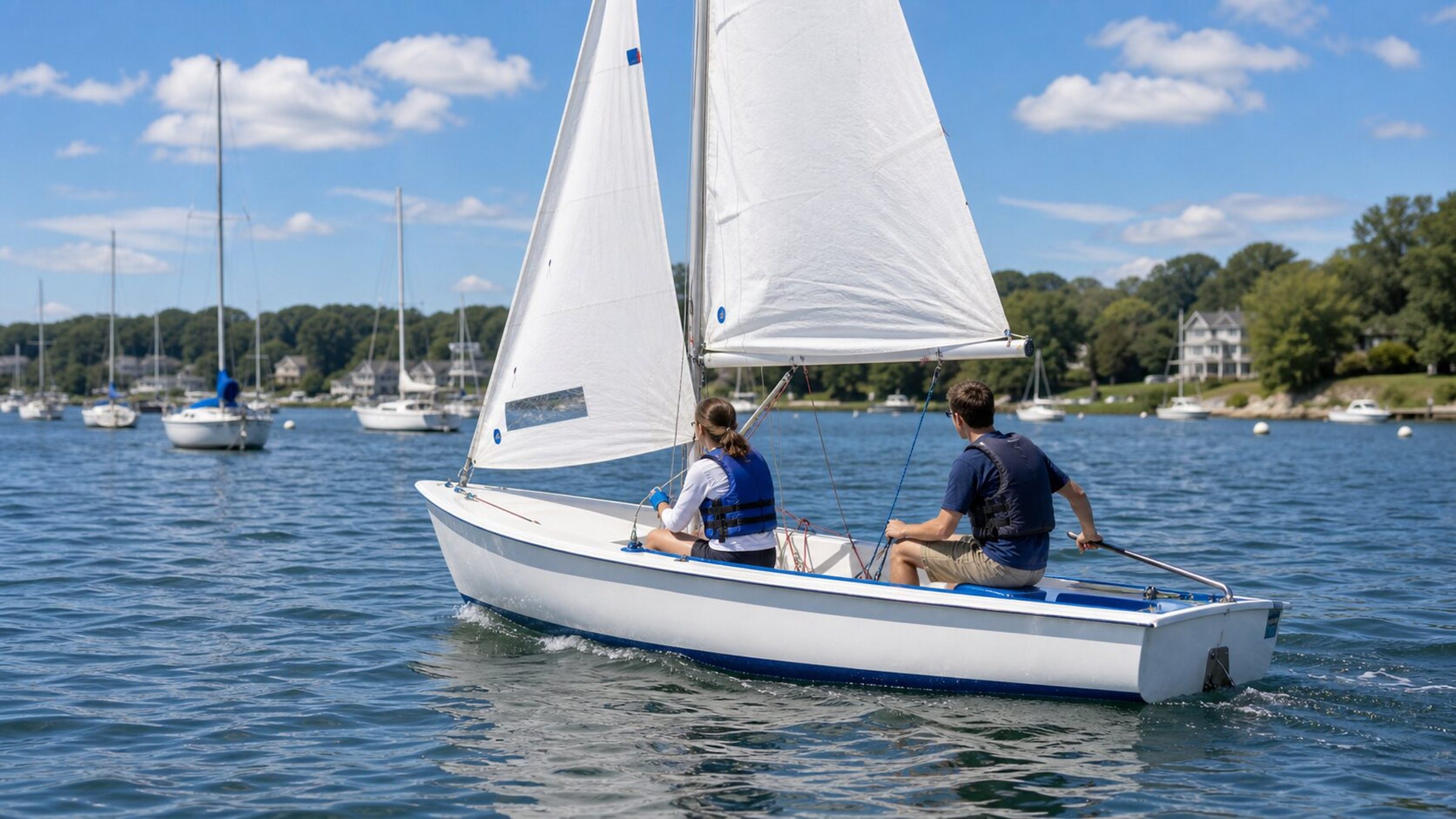
What "beginner-friendly" actually means
Every boat under 30 feet gets marketed as a good starter boat. Many are not, at least not for the same buyer. The problem usually is not danger; it is that some boats punish small mistakes before a new sailor understands what the boat is saying. A beginner-friendly sailboat has a specific set of characteristics, and those are worth naming before you shop.
Forgiving helm. A good starter boat does not require constant correction. It tracks reasonably straight, builds weather helm gradually when overpowered, and responds predictably to the tiller or wheel. The worst boats for beginners feel fine until suddenly they do not — usually when a gust and a close-quarters maneuver arrive together.
A manageable rig. The sail plan should be simple enough to reef and furl without drama, and the boat should not require expert trim to sail acceptably. Most boats on this list are masthead or fractional sloops with one headsail and a main, which is exactly the configuration you want while tacking, gybing, reefing, and docking are still conscious tasks.
Standing headroom and real overnight accommodations. This matters more than it sounds. A boat you can sleep and cook on is one you will use more. Boats you use more are boats you learn faster on. Sub-5-foot headroom turns every overnight into an endurance test, which quietly discourages the time on the water that actually builds skill.
An active used market. The best boat for a beginner is one where the seller already has 10 years of experience with it, where parts are readily available, where the surveyor has seen a dozen of them, and where the online forums have already documented every common failure mode in detail. This is not a romantic criterion, but it is a practical one.
Research linkBrowse all small sailboats under 30 feetTop Small Sailboats for Beginners
These are the models with the deepest track records in the beginner and coastal-cruising market: boats that have put more sailors on the water than almost anything else in their size range.
| Model ↕ | Listings ↓ | Year Built ↕ | LOA (ft) ↕ | Beam (ft) ↕ | Draft (ft) ↕ | Disp. (lbs) ↕ | Hull ↕ | Designer ↕ | Rig ↕ | Keel ↕ |
|---|---|---|---|---|---|---|---|---|---|---|
| Catalina 250 | 38 for sale | 1995 | 25 ft | 8.5 ft | 5 ft | 4,200 lbs | Monohull | — | Masthead Sloop | Fin |
| Catalina 30 Mk II | 36 for sale | 1986 | 29.92 ft | 10.83 ft | 5.25 ft | 10,200 lbs | Monohull | Gerry Douglass | Masthead Sloop | Fin |
| Catalina 270 | 32 for sale | 1992 | 28.33 ft | 9.83 ft | 5 ft | 6,240 lbs | Monohull | Gerry Douglas | Masthead Sloop | Fin |
| Catalina 28 | 32 for sale | 1991 | 28.5 ft | 10.17 ft | 5.25 ft | 8,300 lbs | Monohull | Gerry Douglas | Masthead Sloop | Fin |
| Hunter 29.5 | 32 for sale | 1994 | 29.5 ft | 10.5 ft | 4 ft | 7,500 lbs | Monohull | Rob Mazza/Hunter Design Team | Masthead Sloop | Fin |
| Hunter 306 | 31 for sale | 2001 | 29.92 ft | 10.75 ft | 5.33 ft | 7,150 lbs | Monohull | — | Fractional Sloop | Wing |
| Hunter 28.5 | 28 for sale | 1985 | 28.42 ft | 10.5 ft | 5.18 ft | 7,000 lbs | Monohull | Hunter Design | Fractional Sloop | Fin |
| Catalina 275 Sport | 17 for sale | 2013 | 27.5 ft | 8.5 ft | 5 ft | 5,000 lbs | Monohull | Gerry Douglas | Fractional Sloop | Fin |
| Hunter 26 | 15 for sale | 1994 | 25.75 ft | 9 ft | 6 ft | 4,600 lbs | Monohull | Rob Mazza | Fractional Sloop | Centerboard |
| Catalina Capri 26 | 15 for sale | 1990 | 26.17 ft | 9.83 ft | 4.83 ft | 5,250 lbs | Monohull | Frank Butler/Gerry Douglas | Masthead Sloop | Fin |
| Hunter 28 | 11 for sale | 1989 | 28.01 ft | 10.5 ft | 3.75 ft | 7,400 lbs | Monohull | — | Fractional Sloop | Wing |
| Hunter Horizon 26 | 9 for sale | 1984 | 26.34 ft | 9 ft | 5 ft | 4,564 lbs | Monohull | David Thomas | Fractional Sloop | Fin |
| Pearson 28 (1980-82) | 9 for sale | 1980 | 28 ft | 9.33 ft | 5 ft | 7,850 lbs | Monohull | William Shaw | Masthead Sloop | Fin |
| Hunter 260 | 8 for sale | 1997 | 26.25 ft | 8.96 ft | 6 ft | 5,000 lbs | Monohull | Rob Mazza/Hunter Design Team | Fractional Sloop | Centerboard |
| Hunter 27-2 | 8 for sale | 1989 | 26.58 ft | 9 ft | 3.5 ft | 5,000 lbs | Monohull | Hunter Design Team | Fractional Sloop | Wing |
| Pearson 27 | 7 for sale | 1986 | 26.92 ft | 9.17 ft | 3.33 ft | 5,800 lbs | Monohull | William Shaw | Masthead Sloop | Wing |
| Hunter 25.5 | 3 for sale | 1984 | 25.58 ft | 9.08 ft | 4.5 ft | 4,500 lbs | Monohull | Cortland Steck | Masthead Sloop | Fin |
| Hunter 26.5 | 3 for sale | 1985 | 26.58 ft | 9 ft | 3.5 ft | 4,400 lbs | Monohull | Hunter Design Team | Fractional Sloop | Wing |
| Pearson 28-2 | 3 for sale | 1985 | 28.46 ft | 9.83 ft | 4.83 ft | 7,000 lbs | Monohull | William Shaw | Masthead Sloop | Fin |
| Hunter 27 X | 2 for sale | 2006 | 27.33 ft | 9.91 ft | 5.52 ft | 8,000 lbs | Monohull | Glenn Henderson | Fractional Sloop | Fin |
| Catalina Capri 30 | 2 for sale | 1982 | 29.5 ft | 11.17 ft | 5.33 ft | 4,985 lbs | Monohull | F. Butler | Masthead Sloop | Fin |
| Catalina 276 Sport | 1 for sale | 2024 | 27.5 ft | 8.42 ft | 5 ft | 6,000 lbs | Monohull | Gerry Douglas | Fractional Sloop | Fin |
The standard bearer: Catalina 30
Any conversation about beginner-friendly small sailboats starts with the Catalina 30. With over 6,400 hulls launched between 1974 and 2008, it is one of the deepest used-market keelboats under 30 feet by a wide margin. If you want to buy a used sailboat and know very little yet, the Catalina 30 is the boat around which every other choice is implicitly measured.
At 29.9 feet with a 10'10" beam and 6'2" of headroom in the main cabin, the 30 delivers interior volume that felt revolutionary when it launched and still competes with boats several feet longer. The ballast-to-displacement ratio of roughly 41% makes it stiff and predictable: the boat stands up to a breeze rather than accelerating heel, which gives beginners time to react before a situation becomes a problem.
The production run spans three distinct generations — Mark I (1974–1986), Mark II (1986–1993), and Mark III (1994–2008) — with incremental improvements to the cockpit, transom, and interior. All three sail essentially the same. The differences are mostly cosmetic and ergonomic, not a reason to buy a tired later boat over a well-kept earlier one. For a beginner, condition beats mark.
Two known issues are worth flagging before purchase: the "Catalina Smile" — a hairline crack at the hull-keel joint, often cosmetic but worth investigating — and the wooden compression-post base under the mast, which can rot on boats with neglected bilges. Neither is a deal-killer if identified early, and both are thoroughly documented in the Catalina 30 International Association technical library.
The entry point: Catalina 22
If the Catalina 30 is the benchmark, the Catalina 22 is the on-ramp. More than 15,000 hulls produced since 1969 make it one of the most successful small keelboats ever built. For a beginner on a tight budget, or a sailor who wants to trailer to different lakes and bays, nothing else combines availability, documentation, and low ownership risk as well.
The defining feature is the swing keel: 550 lbs of ballast that drops to five feet of draft under sail or winches up to two feet for trailering. That makes the boat truly portable. You can keep it at home, launch from a ramp, and explore shallow water that a fixed-keel cruiser cannot reach. The pop-top cabin raises at anchor to provide more than six feet of headroom in the main living area, which is extraordinary for a 22-footer.
The honest trade-off is the swing-keel mechanism itself. The pivot pin wears over time, the lifting cable must be inspected for fraying, and the winch needs to operate smoothly. On a neglected boat, a keel failure at the wrong moment is the nightmare scenario, so documented keel maintenance matters more than shiny cushions. Well-maintained examples are plentiful; the owner community is large enough that you can learn what "right" looks like before you inspect one.
Best for: Sailors who want to trail to different bodies of water, buyers on limited budgets, and anyone who wants the deepest possible pool of used inventory and community support.
The sweet spot: Catalina 27
The Catalina 27 occupies the position between the 22 and the 30 that many beginning sailors find ideal: enough boat to spend a weekend aboard comfortably, small enough for a couple to manage, and common enough to be a realistic first purchase. With 6,600 hulls produced between 1971 and 1991 and 6'1" of headroom, it delivers the "big boat feel" Frank Butler promised without the slip fees and systems load of a larger cruiser.
The sailing characteristics are straightforward: moderate displacement of 6,850 lbs, a balanced masthead sloop rig, and a fin keel that provides honest performance without demanding expert helm skills. The boat becomes tender above 15 knots if you do not reef early, which is less a flaw than a useful lesson. The 27 trains you to read the wind and reduce sail before the boat demands it, exactly the habit a new skipper needs.
Structurally, the main items to check on any used example are the chainplate bulkheads (plywood that can rot if chainplate covers weren't recaulked) and the compression post base under the deck-stepped mast. The International Catalina 27/270 Association maintains detailed documentation on both, along with original manuals and a registry of common issues by hull year.
The value case: Pearson 26
The Pearson 26 rarely tops beginner lists but deserves more attention than it gets. Designed by William Shaw and produced from 1970 to 1983, with nearly 5,000 hulls built, it sits in the same general used-market lane as the Catalina 27 but feels more conservative underfoot: nearly 40% ballast-to-displacement in a fin-keel hull that stands up to a breeze with conviction.
At 5'9" of headroom, the interior is not quite the Catalina's, but it is livable for overnights and weekends. The mechanical simplicity is a genuine advantage for beginners: many Pearson 26s use outboard power rather than an inboard, which means no cramped engine access, no raw-water cooling system, and no diesel bleeding procedure to learn. Learning to sail is complicated enough without learning an aging inboard at the same time.
The common issues — balsa-cored deck saturation, spade rudder moisture intrusion, chainplate attachment — are well-understood and well-documented by the Pearson Yacht Owners Association. On a boat this old, a professional survey focused on these specific areas is non-negotiable, but none of these are exotic problems.
The Hunter alternative: Hunter 27 and Hunter 29.5
Hunter Marine built its reputation on the same core premise as Catalina — maximum interior volume at an accessible price — but with a slightly different design emphasis. The classic Hunter 27, designed by John Cherubini and produced from 1975 to 1984, has a higher ballast ratio than the Catalina equivalent, which translates to a stiffer, more confidence-inspiring motion in chop. The 6'1" headroom matches the Catalina 27 directly.
For buyers who want to step up slightly in size without leaving the beginner-accessible range, the Hunter 29.5 is worth knowing. At 7,500 lbs, it is the largest boat on this list that still feels reasonable for a new owner to handle short-handed. The Henderson-designed version brought a B&R rig — no backstay, large roachy main — that improves light-air performance but requires a slightly different sail-trim approach than a traditional masthead sloop.
The trailerable tier: under 24 feet
Not every beginner needs or wants a boat that lives in a slip. The trailerable segment — boats small enough to tow with a capable vehicle and launch at a ramp — opens up sailing to a wider geographic range and can eliminate marina fees while you are learning.
The Catalina 25 is the best option in this sub-range for the same reason the 22 and 27 are on this list: Catalina support, deep owner knowledge, and a design that keeps the systems simple. At 4,550 lbs displacement with a masthead sloop rig, it is docile enough for a beginner but large enough for overnight trips with a partner.
The Precision 23 occupies a smaller niche but deserves mention. A centerboard design at 2,450 lbs with a fractional sloop rig, it is genuinely trailerable and has a devoted class following that appeals to sailors who want to learn in a more competitive environment. The lighter displacement makes it more sensitive to crew movement and wind shifts than the heavier cruising designs. That is a disadvantage for pure comfort but a significant advantage for developing helm feel quickly.
| Model ↕ | Listings ↓ | Year Built ↕ | LOA (ft) ↕ | Beam (ft) ↕ | Draft (ft) ↕ | Disp. (lbs) ↕ | Hull ↕ | Designer ↕ | Rig ↕ | Keel ↕ |
|---|---|---|---|---|---|---|---|---|---|---|
| Catalina 22 | 47 for sale | 1969 | 23.83 ft | 7.67 ft | 5 ft | 2,250 lbs | Monohull | Frank V. Butler | Masthead Sloop | Wing |
| Catalina 25 | 44 for sale | 1976 | 25 ft | 8 ft | 4 ft | 4,550 lbs | Monohull | Frank Butler | Masthead Sloop | Fin |
| Catalina 250 | 38 for sale | 1995 | 25 ft | 8.5 ft | 5 ft | 4,200 lbs | Monohull | — | Masthead Sloop | Fin |
| Catalina 22 Mk II | 15 for sale | 1995 | 23.83 ft | 7.66 ft | 3.5 ft | 2,490 lbs | Monohull | Frank V. Butler | Masthead Sloop | Fin |
| Precision 23 | 9 for sale | 1986 | 23.42 ft | 8.5 ft | 5.33 ft | 2,450 lbs | Monohull | Jim Taylor | Fractional Sloop | Centerboard |
| Catalina Capri 14.2 | 5 for sale | 1983 | 14.17 ft | 6.17 ft | 3.51 ft | 340 lbs | Monohull | Ted Carpentier/Frank Butler | Fractional Sloop | Centerboard |
| Precision 165 | 5 for sale | 1995 | 16.42 ft | 7.16 ft | 1.75 ft | 750 lbs | Monohull | Jim Taylor | Fractional Sloop | Fin |
| Precision 21 | 5 for sale | 1986 | 20.75 ft | 8.25 ft | 4.67 ft | 1,875 lbs | Monohull | Jim Taylor | Fractional Sloop | Centerboard |
| Catalina Expo 12.5 | 4 for sale | 1997 | 12.76 ft | 4.99 ft | 1.75 ft | 130 lbs | Monohull | Garry Hoyt | Cat Rig | Daggerboard |
| Catalina Expo 14.2 | 4 for sale | 1997 | 15.16 ft | 6.16 ft | 3.5 ft | 340 lbs | Monohull | Garry Hoyt | Cat Rig | Daggerboard |
| Catalina Capri 25 | 4 for sale | 1980 | 24.58 ft | 9.16 ft | 4.2 ft | 2,950 lbs | Monohull | — | Masthead Sloop | Fin |
| Catalina Capri 22 | 4 for sale | 1984 | 24.66 ft | 8.17 ft | 4 ft | 2,200 lbs | Monohull | Gary Mull / Frank Butler | Fractional Sloop | Fin |
| Catalina 16.5 | 3 for sale | 1994 | 16.33 ft | 7 ft | 4.42 ft | 430 lbs | Monohull | — | Fractional Sloop | Centerboard |
| Precision 18 | 3 for sale | 1984 | 17.42 ft | 7.42 ft | 4.25 ft | 1,100 lbs | Monohull | Jim Taylor | Fractional Sloop | Centerboard |
| Catalina Capri 16 | 2 for sale | 1987 | 16.5 ft | 6.92 ft | 2.42 ft | 1,350 lbs | Monohull | Frank Butler | Fractional Sloop | Fin |
| Precision 14 | 1 for sale | 1985 | 13.83 ft | 6.08 ft | 2.75 ft | 250 lbs | Monohull | Stephen Seaton | Fractional Sloop | Centerboard |
| Precision 185 | 1 for sale | 2001 | 18.42 ft | 7.33 ft | 3.5 ft | 880 lbs | Monohull | Jim Taylor | Fractional Sloop | Fin |
What's actually being built today: Catalina 276 Sport
Most boats above are used-market classics from the 1970s through the 1990s, which is where the value and deep owner communities live. It is still worth knowing what a beginner-friendly small sailboat looks like in a modern package, because the design language has moved on. The clearest example inside the Catalina family is the Catalina 276 Sport, launched in 2024.
It is a 27.5-foot fractional sloop built around the same accessibility philosophy as the older boats, but with a modern hull form, a fixed fin keel drawing 5 feet, and 2,100 lbs of ballast for a 35% ratio. At 6,000 lbs displacement it is noticeably lighter and more responsive than a Catalina 30, with a capsize screening ratio of 1.85 and a comfort ratio around 20: settled enough to be forgiving, lively enough to reward better sail trim as your skills grow. It belongs here as the answer to "what would I buy new," not as the budget pick.
A note on what is not here: the modern small-multihull market is real, but it skews toward fast folding trimarans and performance cats that demand more from the helm than a forgiving first boat should. Those belong in a trailerable-performance roundup, not a beginner list. If you are specifically drawn to a multihull, look for cruising-oriented designs and budget extra learning time for apparent-wind sailing, wider docking geometry, and different reefing habits.
Comparison: key specs side by side
The differences between these boats are real but rarely obvious from the dock. This is where the numbers matter:
| Model | LOA | Displacement | Ballast Ratio | Headroom | Listings | Median Price |
|---|---|---|---|---|---|---|
| Catalina 22 | 22 ft | 2,250 lbs | ~24% (swing) | 6'2" (pop-top) | Moderate | ~$5,500 |
| Catalina 25 | 25 ft | 4,550 lbs | ~34% | 5'6" | 32 | ~$6,700 |
| Pearson 26 | 26 ft | ~5,500 lbs | ~40% | 5'9" | Multiple | ~$8,000 |
| Catalina 27 | 27 ft | 6,850 lbs | ~37% | 6'1" | Multiple | ~$10,000 |
| Hunter 27 | 27 ft | ~6,000 lbs | ~43% | 6'1" | Multiple | ~$12,000 |
| Hunter 29.5 | 29.5 ft | 7,500 lbs | ~36% | — | 18 | ~$26,450 |
| Catalina 30 | 29.9 ft | 10,200 lbs | ~41% | 6'2" | 169 | ~$18,000 |
The ballast ratio column is worth attention. Boats in the 38–43% range tend to have genuine initial stability: they resist heel confidently and give a beginner time to react when gusted. Boats in the low 30s or below can feel jumpier, particularly in chop where wave action adds to the heeling moment.
What to look for when buying
Condition beats model
Every boat on this list is old enough to have been neglected, refitted, or somewhere in between. A well-maintained Pearson 26 from 1978 is better value than a rough Catalina 30 from 1998. The purchase survey is not optional; it is the transaction. Use a marine surveyor with fiberglass-production-boat experience and ask them to focus on the items unique to each model: deck core, chainplates, keel attachment, compression post, and rudder moisture.
Inboard vs. outboard
Inboard engines are more convenient underway and easier to use in cold or rough weather, but they add complexity and maintenance cost. Outboards are simpler and cheaper to service but require an outboard well or bracket and can ventilate or lift in rough conditions. For a beginner on a limited budget, the outboard-power option on boats like the Pearson 26 or older Catalina 25s can be an advantage: one less system to learn alongside sailing.
Keel type
A fixed fin keel is the default for many of these boats and the simplest to own. A swing keel (Catalina 22, some Catalina 25s) enables trailering but requires maintenance of the lifting mechanism. A wing keel provides shoal draft without the complexity of a lifting mechanism but usually compromises upwind pointing. Know which keel you are buying and why.
Standing headroom
If you are over 5'8", honestly assess headroom before committing. The Catalina 27 and Hunter 27 deliver 6'1", enough for most adults to stand comfortably. The Catalina 25 and Pearson 26 are closer to 5'6"–5'9", which is fine for a weekend but can become tiring on longer stays.
Shopping by budget
The used market for beginner sailboats has historically offered low entry points by the standards of boating. The purchase price is only the first number; the better question is how much cash remains for making the boat trustworthy.
Under $10,000 — This is where the Catalina 22, older Catalina 25s, and project-grade Pearson 26s and Catalina 27s live. Expect meaningful post-purchase spending to make any boat in this range genuinely trustworthy: standing rigging, bottom paint, possible chainplate work, updated safety gear, and often sails.
Research linkBrowse small sailboats under $10,000$10,000–$25,000 — The sweet spot. Better-condition Catalina 27s and 30s, solid Hunter 27s, and cleaner Pearson 26s. Boats in this range may still need running rigging, sails, batteries, and electronics, but they should be structurally sound and close to usable.
Research linkBrowse small sailboats $10,000–$25,000$25,000–$50,000 — Better-equipped Catalina 30s, late-model Hunter 29.5s, and well-outfitted Catalina 27s with newer sails and electronics. In this range you should expect documented maintenance history and a boat you can provision and sail soon after closing.
Research linkBrowse small sailboats $25,000–$50,000What the first season actually looks like
The most common first-buyer mistake is choosing too much boat: too large, too complex, or too much of a project. The models on this list were selected partly because they scale with skill development. A Catalina 30 you buy as a beginner is still a capable coastal cruiser after you have a season or two of practice and are ready to push farther.
Budget for instruction regardless of which boat you buy. An ASA 101 course or equivalent time with an experienced sailor aboard your specific boat will compress the learning curve dramatically. Owner associations and local clubs are also practical resources; a few hours with someone who already knows the model can prevent months of avoidable frustration.
The practical first-year reality is simple: you will bump the dock, botch at least one anchoring attempt with an audience, and discover at least one system you did not understand during the survey. None of that means you bought the wrong boat. It means you need repetition in manageable conditions.
Refine your search
Looking for something more specific? These filters translate the beginner-sailboat advice above into stability, size, and keel-type constraints.
By stability:
Research linkWell-ballasted hulls (ballast ratio 38%+)Research linkConservative capsize screening (ratio under 2.0)By size:
Research linkTrue trailerable starters (under 24 feet)Research linkLarger entry-level cruisers (27–30 feet)By keel type:
Research linkFixed fin keel only (no swing or centerboard maintenance)Research linkCenterboard and swing keel trailerable designs