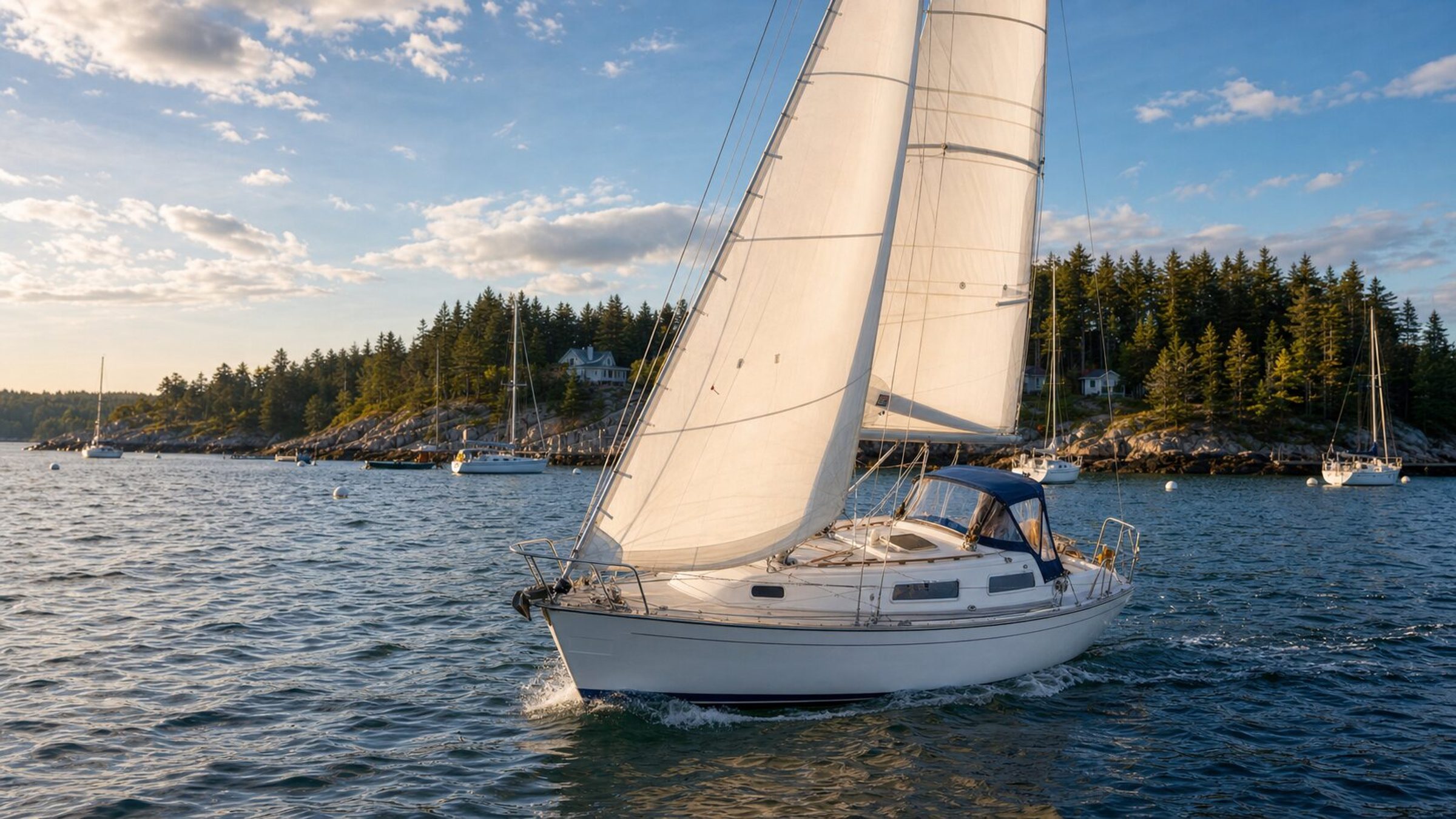
Thirty feet is where sailboat ownership gets practical. Under that number, you are not daydreaming about a boat so large it needs a crew and a full marina budget. You are buying one, trailering it or keeping it in an affordable slip, and going sailing this weekend. The 30-foot constraint forces clear decisions in ways bigger budgets often do not.
The pocket cruiser category has produced some of the most useful production sailboats ever built. These boats were engineered to compete on price, which meant they had to deliver disproportionate value: standing or near-standing headroom, enclosed heads, sleeping space for a small crew, and systems a two-person crew could manage alone. Many of those designs are still the right answer today.
This guide focuses on fiberglass production sailboats you can actually find and buy. The cheap end of this market often starts with old but serviceable boats; the value sweet spot is a well-maintained example with sound rigging, usable sails, and no major core or keel surprises.
The Standard Bearer: Catalina 27
No boat has done more to define this category than the Catalina 27. Over 6,600 were built between 1971 and 1991. It is the benchmark not because it is the best at any one thing, but because it is genuinely good at the ordinary jobs a coastal cruiser needs to do.
At 26.83 feet LOA with 6'1" of standing headroom, the Catalina 27 offered an interior that felt closer to a 30-footer than a 27-footer when it launched. The masthead sloop rig is conservative and manageable. The hull is stiff enough to feel secure and light enough to move in 8 knots of breeze. It tracks well, tacks reliably, and rewards a reef taken early.
The Tall Rig option added two feet to the mast and made a meaningful difference in light-air performance, which is worth seeking out in summer-light venues such as the Chesapeake or parts of the Pacific Northwest. Later models refined the interior layout and engine access. All of them benefit from the same large owner community and the parts catalog that Catalina Direct still maintains.
Known issues are well-documented: the Catalina Smile at the keel-to-hull joint, deck-core saturation around stanchion bases, and chainplate-bulkhead rot if water has been entering through the deck fittings. Survey the chainplates, mast-support structure, and keel attachment carefully on any example old enough to have deferred maintenance.
For buying, the key is not the model year; it is whether the boat has updated standing rigging, decent sails, a dry deck, and an engine installation you can trust.
The Volume Leader: Catalina 25
If the Catalina 27 is the benchmark, the Catalina 25 is the entry point. Over 5,000 were built from 1978 through the early 1990s, making it one of the most common small fiberglass cruisers in North America.
The key feature is the pop-top: a fiberglass roof section that lifts to provide over six feet of headroom at anchor without adding freeboard that would make the boat awkward under sail. It is a clever compromise, and it works. Below that, you get an enclosed head, a V-berth forward, and a quarter berth aft — proper cruising accommodations in 25 feet.
Three keel configurations exist. The swing keel draws 2'10" up and opens up shallow-draft gunkholing but adds cable, pivot, and winch maintenance. The fin keel is the better sailing version. The wing keel is the shoal-draft compromise. Choose by where you sail: ramp and skinny water favor swing or wing; upwind performance favors fin.
The Catalina 25 sails conservatively. It will not embarrass you, and it will not thrill you. For a beginner sailboat or weekender, that is not a criticism; it is an asset. The same owner community and parts network that supports the 27 applies here, which matters enormously when you are tracking down a replacement portlight seal or rudder gudgeon.
The Budget Entry: O'Day 25
The O'Day 25 was built from 1975 to 1984 and represents the value end of the pocket-cruiser market. Designed by C.R. Hunt & Associates, it prioritizes on-deck living and interior volume over performance. The hull is beamy for its length, which means more interior space and less pointing ability: the classic trade-off.
Where the O'Day 25 earns its place on this list is accessibility. These boats are common, well-understood, and simple enough for a practical owner to maintain. For a first sailboat on a tight budget, that matters more than the extra pointing ability you might get from a Pearson or Catalina.
The O'Day 27 is a step up in the same family. Designed by Alan Gurney and produced from 1972 to 1979, it is a better sailing boat than the 25, with more stiffness and a more settled feel. If the 25 feels too small for your cruising plans, the 27 is the natural next step.
The Character Boat: Cape Dory 25
The Cape Dory 25 is the non-obvious pick on this list, and it is worth thinking about carefully. Built from 1973 to 1982, only a few hundred were produced — far fewer than the Catalinas or Hunters. It is not a quick boat. It is a proper boat.
The Cape Dory 25 has full sections, a full keel, and a transom-hung rudder. It displaces proportionally more than its competitors. The D/L ratio is high enough that the boat moves through chop rather than skipping over it, which translates to a more comfortable motion in rougher water than the lighter flat-bottomed production boats can usually match. It points well for what it is, but speed is not the selling point.
The interior is modest — standing headroom is limited without the pop-top options of the Catalinas — but the construction quality is stronger than much of the volume-builder competition from the same era. Buyers who want a small boat that feels conservative, solid, and repairable keep coming back to Cape Dory.
The downside is scarcity. Fewer exist, so finding one takes patience. Parts support is also different from Catalina ownership; you are usually sourcing standard marine hardware rather than model-specific components.
The Trailerable Option: MacGregor 25
The MacGregor 25 (also badged as the Venture 25) occupies a different category from the fixed-keel coastal cruisers above. At 2,100 lbs displacement with a centerboard, it is genuinely trailerable behind an appropriate tow vehicle. Over 7,000 were built.
The trade-off is sailing performance. The MacGregor 25 is tender in a breeze and makes more leeway than the heavier fixed-keel boats. It is not a passage-making boat and not a heavy-weather boat. What it is: a platform for introducing people to sailing on protected water, and a boat that can be stored in a driveway and launched from a ramp without a marina contract.
For sailors who prioritize access over performance — lakes, rivers, sheltered bays — the MacGregor remains one of the most practical options in this size range.
The Pocket Cruiser: Com-Pac 23
The Com-Pac 23 is the choice when trailerable meets serious. Built by The Hutchins Company in Florida, the Com-Pac line was engineered from the start for quality construction and genuine coastal capability in a compact package. The 23 is trailerable, uses a simple fixed shoal keel, and provides better confidence in open water than most lightweight trailer boats.
Com-Pac yachts have a loyal following because they punch above their length. The 23 has an enclosed head, a V-berth, and a galley — everything needed for overnight trips in protected coastal waters. It is the choice for sailors who want trailer convenience but refuse to give up the settled feel of a heavier boat.
Comparison: Key Specs Side by Side
| Boat | LOA | Displacement | Ballast | Draft | SA/Disp | Ballast/Disp |
|---|---|---|---|---|---|---|
| Catalina 27 | 26.8 ft | 6,850 lbs | 2,500 lbs | 4.0 ft (fin) | ~16.5 | 36.5% |
| Catalina 25 | 25.0 ft | 4,200 lbs | 1,500 lbs | 4.0 ft (fin) | ~17.5 | 35.7% |
| Hunter 27 | 27.2 ft | 6,350 lbs | 2,400 lbs | 3.9 ft | ~16.8 | 37.8% |
| O'Day 27 | 27.0 ft | 6,000 lbs | 2,100 lbs | 3.8 ft | ~17.0 | 35.0% |
| Cape Dory 25 | 24.8 ft | 5,200 lbs | 2,100 lbs | 3.7 ft | ~14.5 | 40.4% |
| Com-Pac 23 | 23.0 ft | 3,200 lbs | 1,200 lbs | 3.2 ft | ~16.0 | 37.5% |
The ballast-to-displacement ratios tell you something important: the Cape Dory is the stiffest boat in this comparison relative to its weight, while the MacGregor sits outside the table because its centerboard/trailerable brief is different. Higher ballast ratios generally mean more resistance to heel, which matters if you sail in open water with passengers who are not sailors.
Hunter 27: The Alternative Standard
The Hunter 27 is the other mainstream coastal-cruiser standard. Hunter Marine built it with a focus on usable interior volume and simplified systems: its answer to the same problem Catalina was solving, but with different design priorities.
The Hunter 27 tends to have more cockpit volume and a more open interior than the Catalina 27 of the same era. It is slightly beamier, which contributes to both interior volume and initial stability. Sailing performance is comparable: predictable, forgiving, not exciting. The Pearson 26 offers a similar level of conservative quality and is worth considering if you find a clean example.
The Modern Pick: Catalina 276 Sport
The boats above are mostly 30–50 years old, and for good reason: the used market under 30 feet is dominated by the great production runs of the 1970s and 1980s. But the category is not frozen. If you want something modern, with current systems and less inherited maintenance, the Catalina 276 Sport is the most direct descendant of this article's standard bearer.
Launched in 2024 as the successor to the 275 Sport, it is Catalina's attempt to recapture the accessible day-racing-plus-weekending formula in a contemporary hull. At 27.5 feet and 6,000 lbs with a 5-foot fin keel, it sits close to the classic Catalina 27 on displacement, but with a taller, more efficient fractional rig and a self-tacking jib that makes it genuinely shorthandable. The interior is simpler than the old 27's — this is a weekender, not a four-berth coastal cruiser — but the build is current, and you are not inheriting someone else's 40-year-old wiring.
For sailors who want the Catalina pedigree without old-boat survey anxiety, this is the answer. The trade-off is cost: a new or nearly new 276 Sport lives in a very different budget from a clean used Catalina 27.
The other modern option worth a look is the J/9, J Boats' 2021 daysailer. At 28 feet with a SA/D near 27, it is a performance boat first and a weekender second — the opposite priority from the Catalina. If you care more about how the boat feels in 12 knots than how many berths it has, the J/9 is the modern pick.
The Trailerable Trimaran: Corsair F-24 Mk II
Most "under 30 feet" lists are entirely monohull, and that is a blind spot. A folding trimaran occupies the same trailerable footprint as a MacGregor 25 but sails like nothing else on this list. The Corsair F-24 Mk II is the one most buyers should understand first.
Ian Farrier's patented folding system brings the boat's nearly 18-foot sailing beam down to 8'2" for trailering. On the water, the difference is categorical: a SA/D ratio near 39, more than double any monohull in the comparison table, means the F-24 can reach double-digit speeds and barely heels. The daggerboard retracts to a one-foot draft, so you can beach it like a dinghy. The cabin is "luxury camping" rather than yacht cruising — a V-berth, two settees, and a pop-top for standing headroom at anchor — which is the honest trade for the speed.
It is not for everyone. Trimarans demand a different rigging drill at the ramp, the interior will not satisfy a cruiser who wants a real galley, and folded-trailer height needs checking against your garage and route. But for a sailor under 30 feet who values performance and shallow-water access over interior volume, no monohull here comes close.
"Best For" Framing
Best beginner sailboat: Catalina 25 or Catalina 27. The owner communities are unmatched, technical help is everywhere, and parts are available. You will not be alone with a problem.
Best trailerable boat: Com-Pac 23 for coastal capability, MacGregor 25 for pure accessibility and low cost.
Best value on a tight budget: O'Day 25 or O'Day 27. Lower entry prices, solid construction, and well-understood boats. Keep money aside for sails, rigging, safety gear, and bottom work.
Best for rough water: Cape Dory 25. The full keel and conservative design provide a motion that lighter boats can't match.
Best for solo sailing: Any boat with a well-led mainsheet, roller-furling headsail, and cockpit-friendly controls — but the Catalina 27 Tall Rig is particularly well-balanced for shorthanded work.
Best modern boat: Catalina 276 Sport for a current-production weekender with the Catalina pedigree, or the J/9 if you want a performance daysailer over interior volume.
Best for outright speed: Corsair F-24 Mk II. The folding trimaran is the only configuration here that genuinely outsails everything else, and it's the most available multihull on the used market.
The Collection
| Model ↕ | Listings ↓ | Year Built ↕ | LOA (ft) ↕ | Beam (ft) ↕ | Draft (ft) ↕ | Disp. (lbs) ↕ | Hull ↕ | Designer ↕ | Rig ↕ | Keel ↕ |
|---|---|---|---|---|---|---|---|---|---|---|
| Dragonfly 28 | 28 for sale | 2009 | 28.71 ft | 21.33 ft | 5.58 ft | 4,189 lbs | Trimaran | Jens Quorning | Fractional Sloop | Centerboard |
| Corsair 880 | 21 for sale | 2019 | 28.87 ft | 22.31 ft | 5.25 ft | 3,660 lbs | Trimaran | — | Fractional Sloop | Daggerboard |
| Corsair 27 | 18 for sale | 1986 | 27 ft | 19.08 ft | 4.92 ft | 2,690 lbs | Trimaran | Ian Farrier | Fractional Sloop | Daggerboard |
| Corsair 760 | 17 for sale | 2018 | 24.25 ft | 17.91 ft | 5.25 ft | 2,094 lbs | Trimaran | François Perus | Fractional Sloop | Daggerboard |
| Saffier SE 24 | 16 for sale | 2023 | 26.25 ft | 7.87 ft | 4.27 ft | 2,646 lbs | Monohull | Dean Hennevanger | Fractional Sloop | Bulb |
| Corsair F-24 Mk II | 14 for sale | 1994 | 24.17 ft | 17.92 ft | 4.67 ft | 1,800 lbs | Trimaran | Ian Farrier | Fractional Sloop | Daggerboard |
| Corsair Dash 750 | 12 for sale | 2006 | 24.25 ft | 18.14 ft | 5.25 ft | 1,870 lbs | Trimaran | Farrier/Corsair | Fractional Sloop | Daggerboard |
| Saffier SE 27 | 11 for sale | 2020 | 29.69 ft | 8.53 ft | 4.59 ft | 4,189 lbs | Monohull | Dean Hennevanger | Fractional Sloop | Bulb |
| J-Boats J/9 | 10 for sale | 2021 | 27.95 ft | 8.6 ft | 4.9 ft | 4,250 lbs | Monohull | Alan Johnstone | Fractional Sloop | Fin |
| Hobie Mirage Tandem Island | 9 for sale | 2007 | 18.5 ft | 10 ft | 2.42 ft | 240 lbs | Trimaran | Greg Ketterman | Cat Rig | Centerboard |
| Corsair Sprint 750 | 8 for sale | 2005 | 24.25 ft | 18.16 ft | 5.25 ft | 1,700 lbs | Trimaran | Ian Farrier | Fractional Sloop | Daggerboard |
| Dragonfly 800 | 8 for sale | 1986 | 26.25 ft | 19.85 ft | 4.1 ft | 2,425 lbs | Trimaran | Børge Quorning | Fractional Sloop | Daggerboard |
| J-Boats J/7 | 7 for sale | 2024 | 23.11 ft | 8.11 ft | 3.8 ft | 2,300 lbs | Monohull | Alan Johnstone | Fractional Sloop | Bulb |
| Dragonfly 25 | 5 for sale | 1981 | 25.25 ft | 19.67 ft | 4.58 ft | 1,500 lbs | Trimaran | Børge Quorning | Fractional Sloop | Daggerboard |
| Pulse 600 | 4 for sale | 2015 | 19.68 ft | 14.76 ft | 3.94 ft | 1,010 lbs | Trimaran | Corsair Marine | Fractional Sloop | Daggerboard |
| Telstar 28 | 4 for sale | 2003 | 27.49 ft | 18.01 ft | 4.27 ft | 3,000 lbs | Trimaran | Tony Smith | Fractional Sloop | Centerboard |
| Corsair 28 | 4 for sale | 2001 | 28.52 ft | 19.75 ft | 4.92 ft | 2,690 lbs | Trimaran | Ian Farrier | Fractional Sloop | Daggerboard |
| Astus 16.5 | 3 for sale | 2016 | 16.21 ft | 12.47 ft | 3.61 ft | 463 lbs | Trimaran | VPLP Design | Fractional Sloop | Centerboard |
| Windrider 17 | 3 for sale | 2002 | 17.33 ft | 11 ft | 1.5 ft | 320 lbs | Trimaran | Jim Brown/Windrider | Fractional Sloop | Multihull |
| Dragonfly 25-2 | 3 for sale | 2015 | 25.1 ft | 19.03 ft | 4.92 ft | 2,315 lbs | Trimaran | Jens Quorning and Steen Olsen | Fractional Sloop | Daggerboard |
| Bente 28 | 3 for sale | 2022 | 28.38 ft | 9.81 ft | 5.25 ft | 7,055 lbs | Monohull | Judel/Vrolijk & Co. | Fractional Sloop | Bulb |
| Windrider 16 | 2 for sale | 1995 | 16.58 ft | 12 ft | 1.33 ft | 250 lbs | Trimaran | Jim Brown/Windrider | Cat Rig | Multihull |
| Astus 20.5 | 2 for sale | 2018 | 19.52 ft | 14.76 ft | 4.1 ft | 1,036 lbs | Trimaran | VPLP Design | Fractional Sloop | Centerboard |
| Tri Sea Pearl 21 | 2 for sale | 1993 | 21 ft | 14 ft | 2.67 ft | 950 lbs | Trimaran | Marine Concepts | Cat Ketch | Centerboard |
| Bandit 870 | 2 for sale | 2010 | 28.54 ft | 22.64 ft | 5.91 ft | 4,189 lbs | Trimaran | Pierre Rolland | Fractional Sloop | Centerboard |
| Astus 20.2 | 1 for sale | 2010 | 19.52 ft | 13.94 ft | 3.61 ft | 772 lbs | Trimaran | Perspective Yacht Design | Fractional Sloop | Centerboard |
| Corsair F-24 | 1 for sale | 1992 | 24.17 ft | 17.92 ft | 4.67 ft | 1,800 lbs | Trimaran | Ian Farrier | Fractional Sloop | Daggerboard |
| Cape Cod 767 | 1 for sale | 2023 | 25.16 ft | 8.33 ft | 5.91 ft | 2,756 lbs | Monohull | Hervé Nollet | Solent | Centerboard |
| Catalina 276 Sport | 1 for sale | 2024 | 27.5 ft | 8.42 ft | 5 ft | 6,000 lbs | Monohull | Gerry Douglas | Fractional Sloop | Fin |
What Ownership Actually Looks Like
Many of these boats are 30–50 years old. That is not automatically a problem; fiberglass hulls from this era can be robust. It does mean the ownership experience is different from buying a newer boat.
Budget for a survey before purchase. Budget for standing-rigging replacement if you cannot verify its age: chainplates, turnbuckles, shrouds, and the forestay should all be on the checklist. Budget for sails as well. Used boats rarely come with sails as good as the listing photos suggest.
The good news: the most common boats on this list have active owner associations, Facebook groups, and forum archives with thousands of documented repair threads. Whatever issue you encounter, someone has probably solved it before and written about it.
Marina costs are modest compared with larger boats, but they still vary sharply by region. Slip fees, insurance, winter storage, haul-outs, and bottom paint can exceed the annual repair budget on an inexpensive boat. Price the local ownership ecosystem before you decide a "cheap" hull is truly cheap.
The 30-foot ceiling forces honesty about what you need. A well-prepared Catalina 27 can make serious coastal trips, but it will ask more patience, weather judgment, and humility than a larger cruiser. That is not a flaw; it is what makes sailing at this scale feel like sailing rather than simply moving between marinas with a mast up.
Research linkBrowse all sailboats under 30 feet (monohull, catamaran, trimaran)Research linkPocket cruisers under $15,000Research linkTrailerable sailboats with retracting underbody (centerboard, lifting, swing, folding tri)