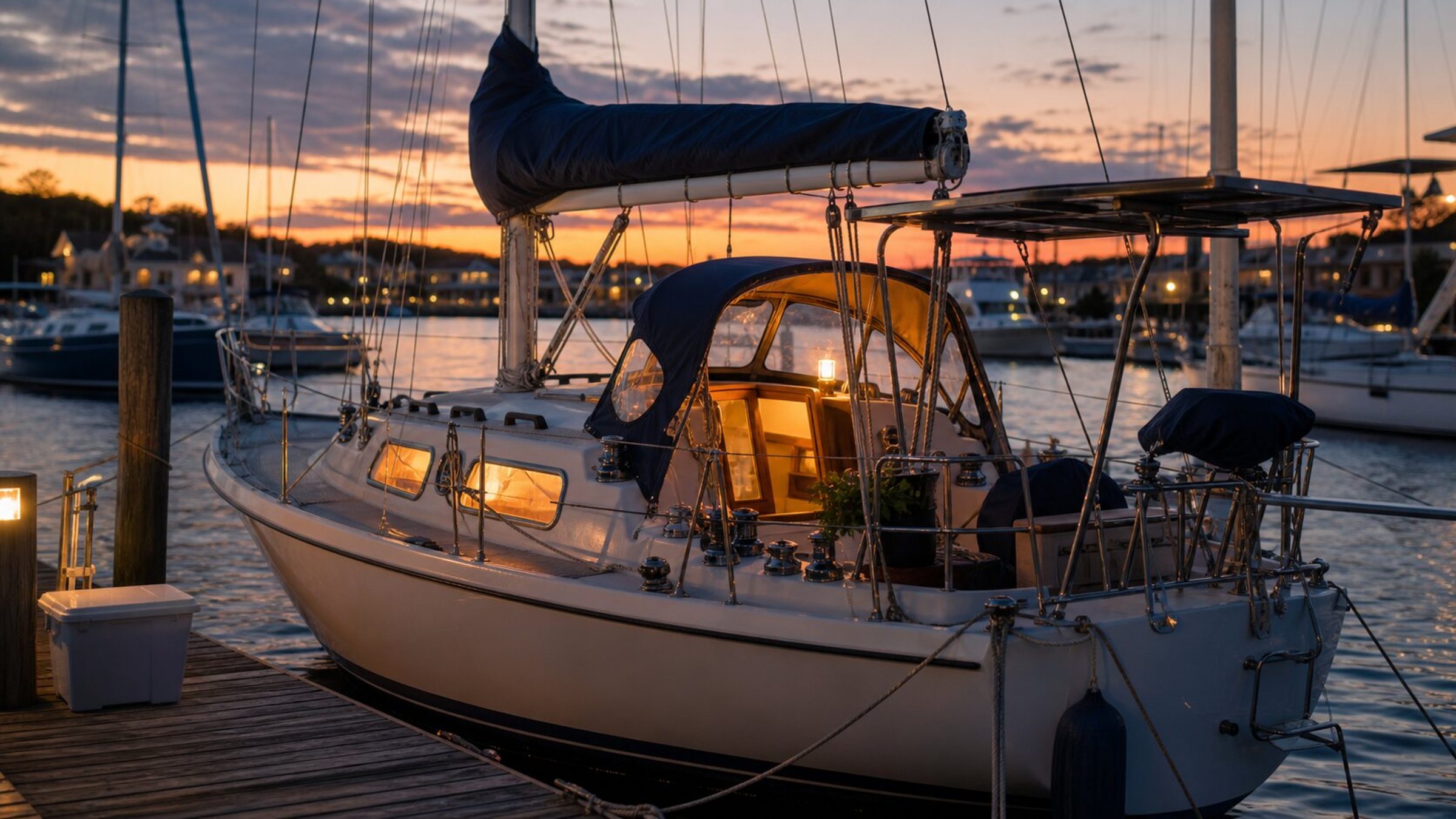
Living aboard a sailboat under 30 feet sounds like a compromise. It is really a different set of tradeoffs. Slip fees are lower. The boat is easier to handle solo. Haulouts, sails, docklines, and bottom paint all cost less. The used market is broad, with entry points under $15,000. And the best designs in this range were built for extended coastal cruising, not just fair-weather weekends.
That does not make every sub-30-footer a liveaboard candidate. A race-focused design with a cramped V-berth, minimal tankage, and no standing headroom can feel clever during a showing and miserable by month two. The boats worth considering are the practical coastal cruisers: real berths, real galleys, usable storage, protected cockpits, and enough vertical clearance to cook dinner without a permanent slouch.
Here's what to actually look for, and which models to seriously consider.
Top Liveaboard Sailboats Under 30 Feet
These boats were selected for liveaboard suitability in the 25–30 foot range — prioritizing standing headroom, water capacity, comfortable berths, serviceable systems, and reliable inboard power. They are sorted by listings count to surface the models with the most active used market.
| Model ↕ | Listings ↓ | Year Built ↕ | LOA (ft) ↕ | Beam (ft) ↕ | Draft (ft) ↕ | Disp. (lbs) ↕ | Hull ↕ | Designer ↕ | Rig ↕ | Keel ↕ |
|---|---|---|---|---|---|---|---|---|---|---|
| Catalina 30 | 193 for sale | 1976 | 29.92 ft | 10.83 ft | 5.25 ft | 10,200 lbs | Monohull | Frank Butler | Masthead Sloop | Fin |
| Catalina 28 | 32 for sale | 1991 | 28.5 ft | 10.17 ft | 5.25 ft | 8,300 lbs | Monohull | Gerry Douglas | Masthead Sloop | Fin |
| Catalina 28 Mk II | 32 for sale | 1995 | 29.42 ft | 10.33 ft | 5.17 ft | 8,300 lbs | Monohull | — | Masthead Sloop | Bulb |
| Hunter 29.5 | 32 for sale | 1994 | 29.5 ft | 10.5 ft | 4 ft | 7,500 lbs | Monohull | Rob Mazza/Hunter Design Team | Masthead Sloop | Fin |
| Hunter 306 | 31 for sale | 2001 | 29.92 ft | 10.75 ft | 5.33 ft | 7,150 lbs | Monohull | — | Fractional Sloop | Wing |
| Beneteau Oceanis 281 | 23 for sale | 1995 | 28.5 ft | 9.42 ft | 4 ft | 5,732 lbs | Monohull | Groupe Finot | Masthead Sloop | Bulb |
| Vancouver 28 | 18 for sale | 1986 | 28.02 ft | 8.66 ft | 4.27 ft | 8,960 lbs | Monohull | Robert Harris | Cutter | Long |
| Pacific Seacraft Dana 24 | 17 for sale | 1984 | 27.25 ft | 8.58 ft | 3.83 ft | 8,000 lbs | Monohull | William Crealock | Cutter | Long |
| Cape Dory 28 | 16 for sale | 1974 | 28.1 ft | 8.87 ft | 4 ft | 9,000 lbs | Monohull | Carl Alberg | Masthead Sloop | Full |
| Shannon 28 | 15 for sale | 1978 | 28 ft | 9.5 ft | 4.25 ft | 9,300 lbs | Monohull | Walter Shultz | Cutter | Fin |
| Catalina 30 Mk III | 14 for sale | 1990 | 29.92 ft | 10.83 ft | 5.25 ft | 10,185 lbs | Monohull | — | Masthead Sloop | Fin |
| Freedom 30 | 14 for sale | 1986 | 29.97 ft | 10.75 ft | 5.5 ft | 7,660 lbs | Monohull | Gary Mull | Fractional Sloop | Fin |
| Nonsuch 26 | 12 for sale | 1981 | 26 ft | 10.5 ft | 4.5 ft | 8,500 lbs | Monohull | Mark Ellis Design | Cat Rig | Fin |
| Bristol 29.9 | 12 for sale | 1977 | 29.92 ft | 10.17 ft | 4.33 ft | 8,650 lbs | Monohull | Halsey Herreshoff | Masthead Sloop | Fin |
| Dufour Arpege 30 | 6 for sale | 1966 | 30 ft | 9.92 ft | 0 | 7,700 lbs | Monohull | Michel Dufour | Masthead Sloop | Fin |
| Hunter 290 | 4 for sale | 1999 | 28.58 ft | 10.75 ft | 5.33 ft | 7,400 lbs | Monohull | Hunter Design Team | Fractional Sloop | Bulb |
| Nor'Sea 27 | 2 for sale | 1976 | 27 ft | 8 ft | 3.5 ft | 8,100 lbs | Monohull | Lyle Hess | Masthead Sloop | Long |
The Standing Headroom Problem
This is the first filter, and it eliminates most of the fleet. On a 28-footer, getting 6 feet of headroom in the main cabin requires a deliberately tall cabin trunk — a design choice that adds windage and rarely looks as elegant as a low-profile racer. Builders who chased headroom at this length were unapologetically pragmatic, and their boats show it.
The Catalina 30 is the benchmark here. At nearly 30 feet on deck with 6'3" of headroom in the main cabin, it was designed for the couple who wanted to spend a week aboard at anchor, then a season, then more. More than 6,400 were built between 1976 and 2008, and roughly 170 are listed for sale at any given time — more than any other boat in this size range by a wide margin. Median prices hover around $18,000, with well-maintained examples closer to $30,000 and project boats under $10,000.
The Hunter 306 takes a different approach to the same problem. Its broad beam — nearly 11 feet — creates interior volume that a narrower hull simply cannot match. Headroom is just over 6 feet, and the fractional rig keeps the mast far enough aft to open up the foredeck. The wing keel option brings draft under 4 feet, which matters enormously if you plan to explore shallow coastal anchorages. With 20 listings typically available and a median price around $39,000, it is the more modern choice, and the ergonomics show it.
Water and Storage
The math of living aboard is dominated by two things: where you sleep and where you store water. A 20-gallon tank might last a weekend. For full-time living, 30 gallons is a useful minimum, and 40+ gives meaningful range between fill-ups if you are disciplined with showers and dishwashing.
The Watkins 27 is conspicuously well-equipped for a 27-footer. It carries 40 gallons of water — the same as the Catalina 30 — along with a 20-gallon fuel tank, a skeg-hung rudder for sea-kindly steering, and 6'2" of headroom. About 500 were built, and they routinely trade for under $10,000. For sailors who want to test liveaboard life without a large financial commitment, this is one of the best-kept secrets in the used market.
The Watkins 29 follows the same philosophy at a slightly larger scale: the same 40-gallon water tank, the same skeg-hung rudder, and 8,800 pounds of displacement that soaks up chop better than lighter alternatives in its range. Fewer were built — around 60 — but they are remarkably affordable when they appear.
The Catalina 28 carries 49 gallons of water — more than the Catalina 30 — in a well-organized interior with an aft cabin configuration that gives a couple genuine privacy. Lead ballast, a reliable Universal inboard, and 620 units built across a production run that stretched into the 1990s mean parts and forum help are never hard to find. Median price is around $25,000.
What the "Under 30 Feet" Constraint Actually Means
Thirty feet is a planning constraint, not a performance specification. Understanding what you are trading, and what you are not, helps calibrate expectations.
You are trading: cockpit space, waterline length and therefore hull speed, tankage, battery capacity, and above all, cabin square footage. The difference between a 28-footer and a 35-footer below decks is not subtle.
You are not automatically trading: seaworthiness, maneuverability, or community. A well-built 28-footer can be a serious coastal cruiser. A shorter boat is usually easier to dock single-handed. And the 28-30 foot range is well represented at most marinas, with the Catalina 30 in particular supported by a deep owners' community.
You are gaining: lower slip fees than a 35-footer at the same marina, dramatically lower haul-out costs, cheaper sails and canvas, and a boat you can singlehand without turning every departure into a production.
The Value Cases
The Pearson 28-2 is a quality American boat from the 1985-1989 production run. Its balsa-core construction saves weight without sacrificing stiffness when the core is dry, and the lead ballast on a fin keel gives it a snappier righting moment than heavier iron-ballasted alternatives. Median prices around $12,000 make it an excellent value for a well-built boat with good coastal and near-offshore manners.
The Coronado 30 represents the vintage end of the spectrum. Built from 1969 to 1974, it is a product of the California cruising culture that produced some genuinely seaworthy small boats: lead ballast, substantial displacement at 8,500 pounds, and a comfort ratio that rewards longer passages. Entry prices under $10,000 make it worth a look if you are mechanically capable and willing to invest time in an older boat.
Realistic Expectations for the First Year
Living aboard anything under 30 feet takes adaptation. The first rule of small-boat living is aggressive editing: anything not used regularly goes into storage off the boat. The second rule is that every system matters more when it is also your home — the head, bilge pump, seacocks, stove, battery charger, and freshwater pump. These are not weekend inconveniences; they are daily life.
That said, sailors who have done it consistently often report that the adjustment period is shorter than expected. A well-chosen 28-30 footer gives you enough to be genuinely comfortable and encourages habits — minimal consumption, thoughtful provisioning, living close to the weather — that many people eventually consider upgrades, not sacrifices.
The boats in this guide were chosen because they make that adjustment as easy as possible: genuine headroom, real water capacity, reliable inboard propulsion, and active used markets that make them maintainable on realistic budgets.
Refine Your Search
Looking for something more specific? These filters combine the under-30-foot constraint with the characteristics that actually matter for living aboard: interior volume, sea-kindly motion, displacement, and price.
Research linkAll liveaboard-capable sailboats under 30 ftResearch linkComfortable motion at anchor and underway (comfort ratio 22+)Research linkMaximum interior volume (beam 10 ft+)Research linkHeavy, sea-kindly hulls (8,000 lb+ displacement)Research linkBudget liveaboards under $15,000